
Lot 36
PQ16 ‡
Clandestine Operations - Inc The D.J. Croll Medal Collection & Other Properties | M26002
Auction: 16 September 2026 at 10.30 BST
Description
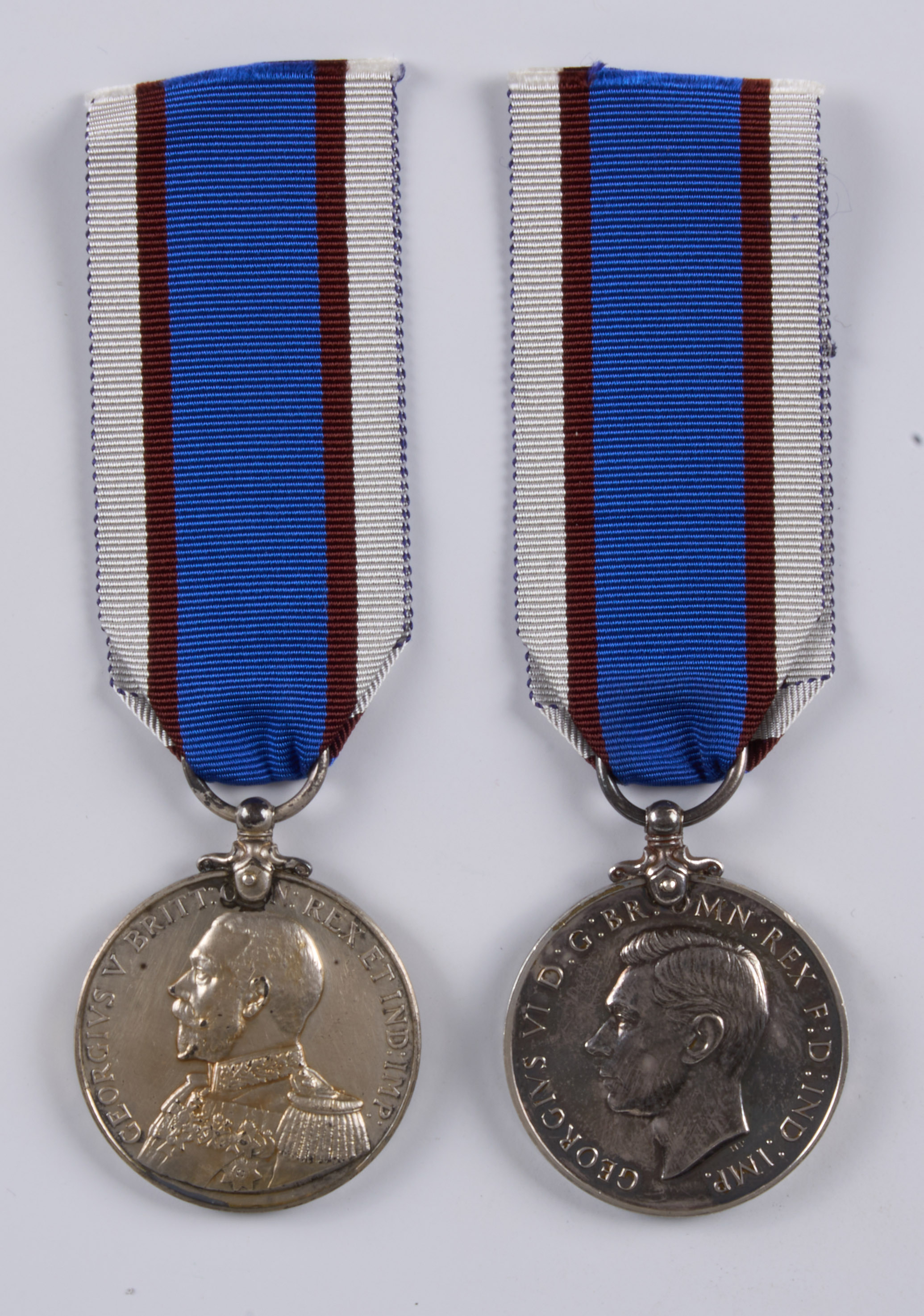
The Royal Fleet Reserve Long Service and Good Conduct Medal awarded to Chief Engine Room Artificer Robert Eaton who was awarded the Distinguished Service Medal for his part in the infamous Arctic Convoy PQ16 comprising R.F.R. LS&GC, GVR, (K.1645 PO. B. 13339 R.J. Eaton. Sto. 1 R.F.R.) and the R.F.R. Long Service Medal to Stoker 1 Albert Stephen Gasston, comprising R.F.R. LS&GC, GVIR, (KX. 76728 PO.D.89 A.S. Gasson. Sto. 1. R.F.R.), note spelling Gasson not Gasston, both fine (2)
DSM the London Gazette the 3rd of November 1942
For Distinguished services in HM Ship’s Achates, Honeysuckle, Hyderabad, and Starwort in taking a Convoy to North Russia through the danger of ice and heavy seas and in the face of relentless attacks by enemy U-Boats, aircraft and surface forces.
Chief Engine Room Artificer Robert Eaton, C/MX. 53907
Convoy PQ 16 (21–30 May 1942) was an Arctic convoy of British, United States and Allied ships from Iceland to Murmansk and Arkhangelsk in the Soviet Union during the Second World War. The convoy was the largest yet and was provided with a considerable number of escorts and submarines. Convoy QP 12, a return convoy, sailed on the same day.
As Operation Barbarossa, the German invasion of the Soviet Union, had failed in 1941, the Germans began to build up forces in Norway to intercept Arctic convoys with ships, aircraft and U-boats, rather than rely on a quick victory. Luftflotte 5, the Luftwaffe force in Norway, was reinforced with bombers and torpedo-bombers in early 1942 and reorganised to attack convoys as they passed between the Norwegian coast and the ice of the Arctic, which was still close to its southern winter limit. The sun remained above the horizon at this time of year, and the deck crews of the ships found the perpetual daylight fatiguing and stressful; glare from ice being particularly difficult for observers.
On 25 May air attacks began, the German bombers and torpedo-bombers co-ordinating their attacks. Torpedo-bombers launched at the same time in the Golden comb tactic to make it harder for ships to evade the torpedoes. The air attacks continued until 1 June and sank six ships; one other being lost to a U-boat; 3–6 German aircraft were shot down and one damaged; on 27 May 108 attacks by aircraft were counted.
After the convoy, the escort commander recommended that convoys be given far more anti-aircraft firepower and air cover from an escort carrier. The Germans claimed the virtual destruction of the convoy and concluded that air operations were more effective than submarine attacks in the long hours of daylight. The Golden comb tactic of combined dive-bombing and torpedo-bombing, with the torpedoes being dropped in a salvo, was vindicated.
Robert J. Eaton was born on the 11th of January 1897 at St Aubyn’s, Devonport, Devon, son of Lieutenant Robert Eaton RN and Rebecca Eaton. He enlisted on the 19th of July 1912 with a rating of Boy, being given the numbers K.1645 and PO.B.13339, his first ship he served on was the Indus.
1916 Promoted ERA5
1917 ERA4
1920 ERA3
1924 ERA2
Robert Eaton received the R.F.R. LS&GC On the 22nd of September 1924. Retiring to Shore on the 15th of December 1927. He re-engaged on the 11th of January 1937 being given the Service Number C/MX.53907. He Died at Sea of Hypertension and Cerebral Haemorrhage on the 10th of August 1950 whilst Serving in the Merchant Navy.
For Eaton Sold with Copy Service Papers WW1 and WW2, Copy London Gazette entry, extract The DSM by Fevyer, genealogical Information and Copy Merchant Seman Death Notice.
For Gasston Sold with Copy Service Papers