
Lot 28
L.R.D.G & Popski's Private Army
Clandestine Operations - Inc The D.J. Croll Medal Collection & Other Properties | M26002
Auction: 16 September 2026 at 10.30 BST
Description
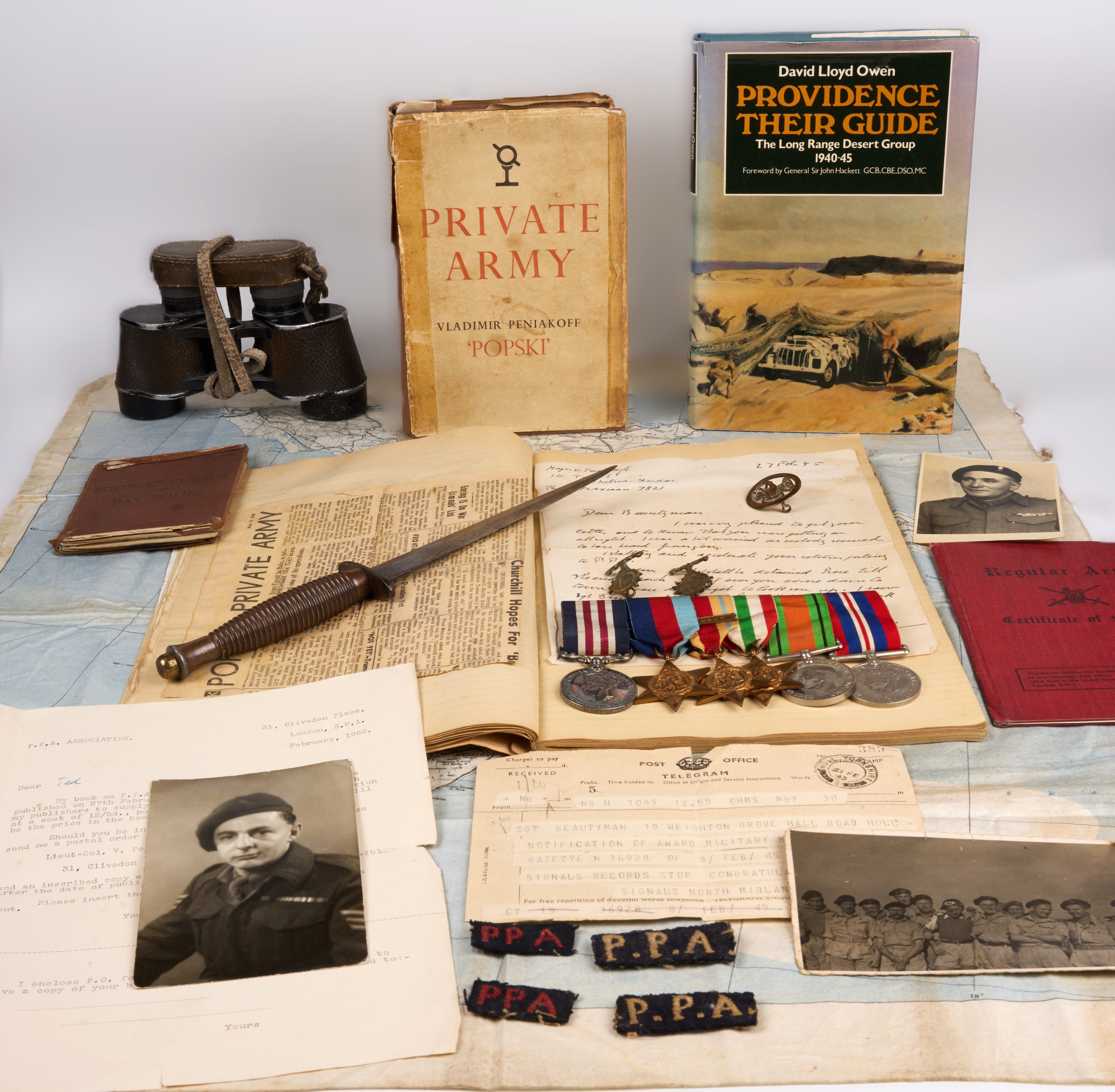
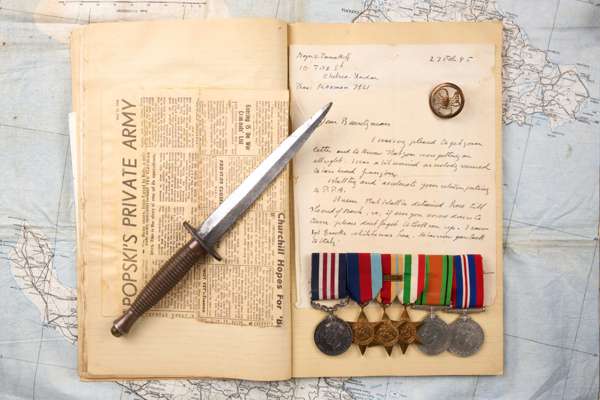
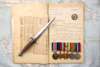
The Outstanding Military Medal Group of 6 awarded to Serjeant John Edward Beautyman, Royal Signals, 1st Demolition Squadron Popski’s Private Army, late Long Range Desert Group who was awarded an Immediate Military Medal recommended by Major V. Peniakoff MC, Officer Commanding 1 Demolition Squadron P.P.A. for an action behind enemy lines when the vehicle in which he was travelling was ambushed, unfortunately in this action the only man killed was his Best Friend, Corporal John Ewen Cameron, PPA, Lovat Scouts No 3 Commando. Comprising, Military Medal, GVR, (2328234 Sjt. J.E. Beautyman. R. Signals.), 1939-45 Star, Africa Star, 8th Army Clasp, Italy Star, 1939-45 Defence Medal, 1939-45 War Medal, all unnamed as issued, Contemporarily Mounted for wear, very fine (5)
Military Medal,
John Edward Beautyman WS/Sgt. Royal Sigs, 1 Demolition Sqdn. P.P.A.
On 21 June 44 near Tolentino, Italy at night, behind enemy lines, the patrol in which he was travelling in the second vehicle fell into an ambush and came under MG fire at very close range. With the utmost coolness he returned the enemy fire and covered the party recovering the leading vehicle which had left the road. Though his vehicle was hit several times he kept up his fire for more than 15 minutes until the patrol proceeded on its way. Owing to his steadiness and to his disregard of danger only one casualty was suffered by the patrol in this encounter.
Popski's Private Army, officially No. 1 Demolition Squadron, PPA, was a unit of British Special Forces set up in Cairo in October 1942 by Major Vladimir Peniakoff (nickname "Popski") who was a Belgian Jewish officer of Russian extraction. Under the name of "Popski's Private Army" it was one of several raiding units formed in the Western Desert during the Second World War. The squadron also served in Italy, and was disbanded in September 1945.
No. 1 Demolition Squadron was formed specifically to attack Field Marshal Rommel's fuel supplies, in support of General Montgomery’s offensive at El Alamein, at the suggestion of Lieutenant-Colonel John Hackett. The unit became operational on 10 December 1942 as an 8th Army Special Forces unit. After the Long Range Desert Group (LRDG) and the Special Air Service (SAS), PPA was the last and smallest of the three main irregular raiding, reconnaissance, and intelligence units formed during the North African Campaign.
Actor Christopher Lee, who served as an RAF intelligence officer during the Second World War was attached as liaison officer to this unit.
Background
When the Second World War broke out, the 42-year-old Peniakoff applied to serve in the Royal Air Force, and the Royal Navy, but was rejected. He was accepted by the British Army and assigned to garrison duties as an Arabic-speaking junior officer in the Libyan Arab Force (LAF). Not satisfied, Popski left his post and formed the Libyan Arab Force Commando (LAFC), a small group of British and Libyan soldiers who operated behind the lines in the Jebel Akhdar area of Cyrenaica.
On his return to Cairo in the middle of 1942, Peniakoff was invited to join a Long Range Desert Group raid in the area he had just left. In doing so, he learned much about German and Italian procedures, but also lost his left little finger to an Italian bullet. He was awarded the Military Cross for his previous intelligence reporting and petrol dump raiding while leading the LAFC for three months behind enemy lines, and for the operation with the LRDG. While he was away, the LAFC was disbanded. He was given the nickname Popski, from a Daily Mirror cartoon character, by Captain Bill Kennedy Shaw (the LRDG's Intelligence Officer) because his signallers had problems with the name "Peniakoff." In fact, Popski was born of Russian Jewish parents who had emigrated to Belgium, although he was educated in Britain.
Formation, and initial actions
Shortly after this No. 1 Demolition Squadron was formed, the smallest independent unit of the British Army at 23 men all-ranks. The original officers of the unit were three friends who had served together in the Libyan Arab Force: Popski, Robert Park Yunnie and Jean Caneri.
Lieutenant Colonel John Hackett, who co-ordinated British raiding operations, asked Peniakoff to give the new unit a cover name, but vacillated. The unit's name ultimately came from Hackett's exasperation at Popski's delay: "You had better find a name quick or we shall call you Popski's Private Army"—"I'll take it". PPA was unusual in that all officer recruits reverted to lieutenant on joining, and other ranks reverted to private. The unit was run quite informally: there was no saluting and no drill, officers and men messed together, every man was expected to know what to do and get on with it, and there was only one punishment for failure of any kind: to be immediately returned to unit. It was also efficient, having an unusually small headquarters.
Events proceeded rapidly; the Germans and Italians were expelled from Egypt and Libya shortly after PPA became active. A joint LRDG-PPA patrol discovered the gap in the mountains that let Bernard Montgomery launch an outflanking move around Erwin Rommel's defence at the Mareth Line. The PPA was also among the first elements of Eighth Army (moving west) to link up with the British First Army and American II Corps (advancing east) in Tunisia in early 1943. Many PPA raiding and reconnaissance operations were carried out around the time of the Battle of Kasserine Pass, including taking the surrender of 600 Italians.
The summer of 1943 was spent in Algeria and Tunisia recruiting and training new volunteers from the LRDG, SAS, Commandos and Royal Armoured Corps for the fight in Italy, bringing the unit's size up to about 35 all ranks, with two fighting patrols and a small HQ. For a short while PPA experimented with using 1st Airborne Division's gliders to deliver them and their jeeps behind the Axis lines in Sicily, but their part in that operation was cancelled at the last minute.
Italy
In September 1943 an advance patrol of PPA sailed to Taranto on board the USS Boise and headed inland, where they discovered the hitherto unknown weakness of the German 1st Parachute Division opposing 1st Airborne. As a result of this success Popski was allowed to increase the size of PPA to 80 all ranks; throughout the Italian Campaign about 100 men were actually deployed at any one time.
Three fighting patrols, each of 18 men in six jeeps, and one Tactical HQ patrol of four jeeps were formed and given great autonomy. Each jeep was armed with .50in and .30in machine guns, giving the patrols immense firepower for their size. The men trained hard for amphibious, mountain and parachute operations, demolition and counter-demolition, reconnaissance and intelligence gathering.
They were deployed in many roles, often clandestine, and for several months even operated as regular front line troops, holding a sector of the Allied front line, badly depleted after the withdrawal of forces for the D-Day landings in Normandy, nipping around in their jeeps to fool the Germans into believing that they were opposed by much larger units.
Several operations used DUKWs or small landing craft called RCLs (manned by 7 Royal Engineers who became known as "Popski’s Private Navy") with sapper John Francis Dobinson to sail up the Adriatic and get behind the German front line, escorted by the Royal Navy’s Coastal Forces.
British troops in Italy, 1945.
Throughout the bitter winter weather and fighting of 1944 and 1945 PPA undertook their operations ahead of regular forces, in support of British, Canadian, Indian and Polish armoured, infantry and commando units. They located targets for the Allied Air Force, chased Germans out of rear-areas, saved bridges, captured many prisoners and guns, and accepted the surrender of the entire German garrison at Chioggia.
At various times PPA worked alongside other secret units such as the LRDG, SAS, No. 1 Special Force (SOE), Phantom, ‘A’ Force and Office of Strategic Services. Along the way they adopted many strays, including Russian, Italian and German POWs, Italian regulars and partisans, both royalist and communist.
Popski was awarded the Distinguished Service Order in November 1944, during joint operations (such as “Porterforce”) with the 27th Lancers and Italian partisans of the 28th Garibaldi Brigade, to liberate Ravenna. Shortly afterwards he lost his left hand to a German rifle-grenade.
At the end of the war Popski’s Private Army sailed some of their jeeps on RCLs to Venice, where they drove around St. Mark's Square, the only wheeled vehicles ever to have been there. The unit was disbanded four months later on 14 September 1945, after hunting for Himmler, disarming Italian partisans and discouraging Josip Broz Tito’s partisans from encroaching on Austrian and Italian territory.
By this time PPA personnel had gained between them a DSO, a Distinguished Conduct Medal, 6 MCs, 10 MMs, and 14 Mentions in Despatches; King George VI had personally requested an account of the unit’s exploits.
John Edward Beautyman was born in 1920; he enlisted at Hull for the Royal Signals on the 19th of November 1938. He Served at Home until being posted to Palestine on the 10th of January 1940. From the Book “Popski’s Private Army” by Vladimir Peniakoff ‘Popski’, Page 330
Beautyman joined the PPA “I got two from L.R.D.G., when I visited Sergeant Beautyman, Yorkshireman signaller, gunner and driver, a man of infinite resources and varied accomplishments, undaunted and reliable, whom I put in command of our headquarters on one occasion when none of our experienced officer were at hand. Beautyman was a restful character: whenever we involved ourselves in a really sticky mess, he could be relied upon to come forward with some imaginative but practical scheme to get out of trouble. If we found ourselves in a pretty desperate position, with our jeeps stick mid-stream between high wooded banks and tracer coming at them on two sides from an unseen enemy, he would suggest something that sounded as false at “seems to me Popski, that if we turn now first left and third right we shall come out opposite South Kensington Tube Station” but was in fact and ingenious way out for our troubles. Eventually he was put in charge of our Signal Section, where he undertook elaborate responsibilities with more success that I can describe without entering into technicalities. He was only 23 when he joined us, and having enlisted at 18 he hadn’t had time to get a civilian job.”
Operation Blitz Page 445
“At midnight, with the partisan guide on the back of my jeep, I led our column in the dark. As our forward troops (along the way we had come) were still one hundred and fifty miles behind us, I thought that the Germans, lulled into a false security, had failed to organise their defence of the river. If we succeeded in crossing it, by the morning we would be deep in enemy territory.
We were coming down the hills into the river valley about a mile and a half from the bridge, when a burst of automatic fire came from a farmhouse on the left, my side of the road. Some bullets hit the floor of the jeep between my legs and drew sparks: I wondered how they had got there without going through me. I stopped the jeep to give Cameron, who was sitting on my right, a chance of answering the fire with his gun, and at the same time turned round to warn the following trucks. Sergeant Mitchell who was next to me, opened up, and Sergeant Beautyman, who drove the third truck did the same. More burst came from the farmhouse but the half-inch gun on my jeep didn’t; fire – surprised, I turned towards Cameron to se what stopped him, and found he wasn’t there.
I walked round and found him lying on the road, wounded and unconscious, where he had slipped out of his seat. With Sergeant Riches, who had some understanding of first aid, I laid Cameron in the ditch, undid his clothing and began to dress his chest wound by the light of a torch; but he was far gone and after a few rattling gasps he gave a deep sigh and died in my arms. Meanwhile our men had stopped firing from the jeeps, and, led on foot by Beautyman, had entered the farmhouse and were apparently clearing it with their tommy guns. A moment later they reported two Germans Dead and some escaped”
Sergeant Beautyman has 13 entries in the Index of the book.
Sold with original LRDG Cap Badge, Two P.P.A. Cap Badges, 4 P.P.A. Shoulder titles. Sgt Beautyman’s “used” Fairburn & Sykes Fighting Knife, Italian Binoculars, a Fist Edition of “Private Army” by Vladimir Peniakoff, signed to frontispiece with personal signed letter to “Ted”. Regular Army Certificate of Service, AB 64, Telegram Congratulations for award of Military Medal, Military Medal Buckingham Palace letter, some one hundred original photographs, including Beautyman in Jeeps in St Mark’s Square Venice. A very large quantity of PPA Association Paperwork, Menus, autographs and newspaper cuttings. Original Photographs of Popski, Beautyman and Corporal Cameron in Desert and Italian locations. Silk Escape map
Sold with Copy MM Citation, Commonwealth War Graves Details for Corporal Cameron. And the 1914-15 Trio to His father.