
Lot 15
H.M.S. Repulse
Clandestine Operations - Inc The D.J. Croll Medal Collection & Other Properties | M26002
Auction: 16 September 2026 at 10.30 BST
Description
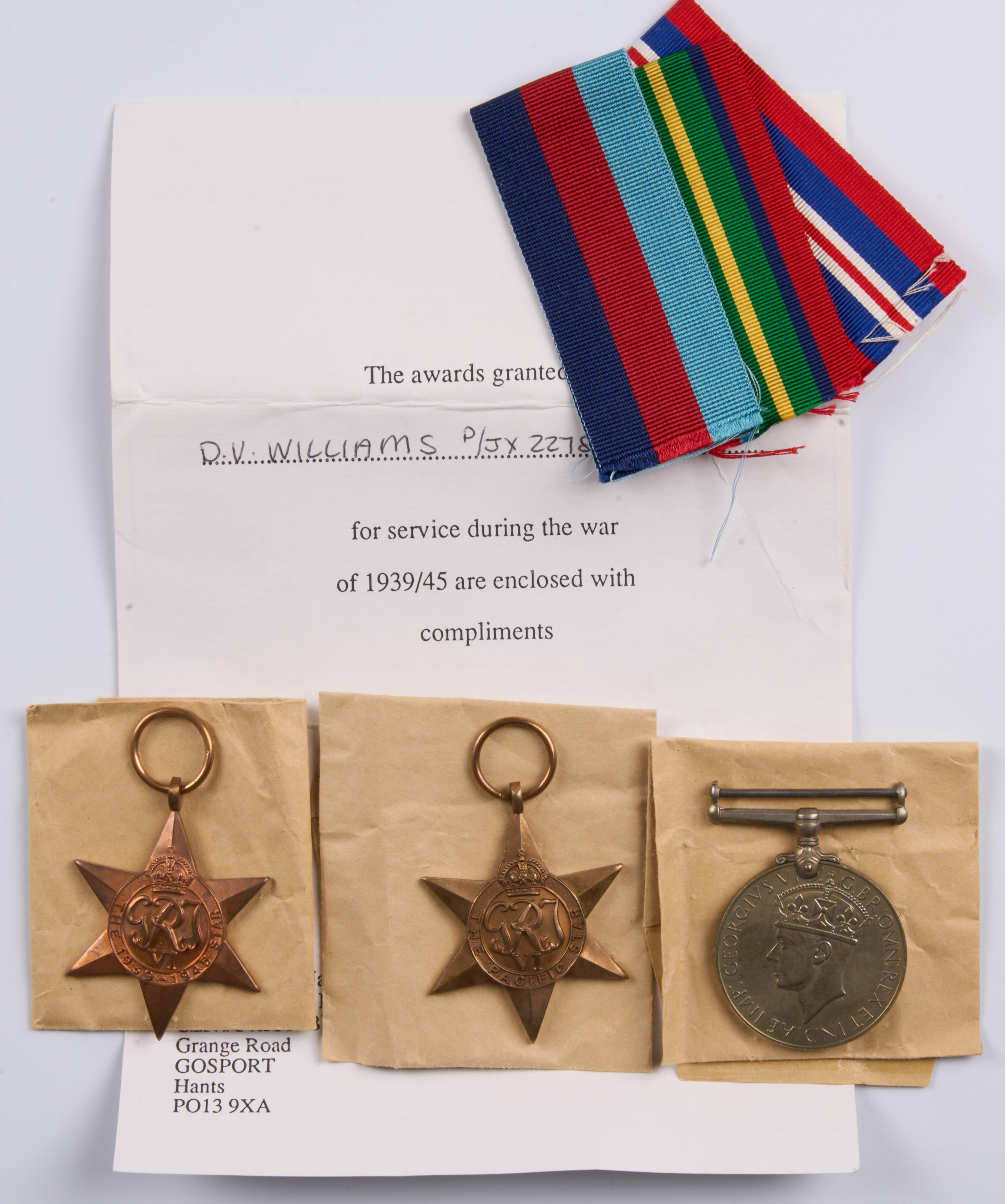
The Modern issue Pacific Casualty Group awarded to Able Seman Douglas Victor Williams, who was Killed in Action on the 10th of December 1941 in the sinking of the Battle Cruiser H.M.S. Repulse, comprising 1939-45 Star, Pacific Star, 1939-45 War Medal, all unnamed as issued, toned very fine (3)
In late 1941 Winston Churchill decided to send a small group of fast capital ships along with one modern aircraft carrier to Singapore, to deter expected Japanese aggression. In November, Repulse which was in the Indian Ocean was ordered to Colombo, Ceylon to rendezvous with the new battleship Prince of Wales. The carrier Indomitable, which was assigned to join them, was delayed when she ran aground in the Caribbean. Prince of Wales and Repulse and their escorting destroyers comprised Force Z, which arrived in Singapore on 2 December 1941. On the evening of 8 December, Force Z set out on an attempt to destroy Japanese troop convoys and protect the army's seaward flanks from Japanese landings in their rear.
Force Z was spotted during the afternoon of 9 December by the Japanese submarine I-65, and floatplanes from several Japanese cruisers spotted the British ships later that afternoon and shadowed them until dark. Admiral Sir Tom Phillips decided to cancel the operation as the Japanese were now alerted. Force Z turned back during the evening, after having tried to deceive the Japanese that they were heading to Singora. At 00:50 on 10 December, Admiral Philips received a signal of enemy landings at Kuantan and correspondingly altered course so that he would arrive shortly after dawn.
The crew of I-58 spotted Force Z at 02:20, reported their position, and fired five torpedoes, all of which missed. Based on this report the Japanese launched 11 reconnaissance aircraft before dawn to locate Force Z. Several hours later 86 bombers from the 22nd Air Flotilla based in Saigon were launched carrying bombs or torpedoes. The crew of a Mitsubishi G3M reconnaissance bomber spotted the British at 10:15 and radioed in several reports. The pilot was ordered to maintain contact and to broadcast a directional signal that the other Japanese bombers could follow.
The first attack began at 11:13 when 551 lb of bombs were dropped from eight G3Ms from an altitude of 11,500 feet. The battlecruiser was straddled by two bombs, then hit by a third which penetrated through the hangar to explode on the armoured deck below. This inflicted a number of casualties and damaged the ship's Supermarine Walrus seaplane, which was then pushed over the side to remove a fire hazard. Anti-aircraft fire damaged five of the Japanese bombers, two so badly that they immediately returned to Saigon. In the ensuing attacks, Repulse was skilfully handled by her captain, Bill Tennant, who managed to avoid 19 torpedoes as well as the remaining bombs from the G3Ms. The gunners on the Repulse shot down two planes and heavily damaged eight more. However, Repulse was then caught by a synchronised pincer attack by 17 Mitsubishi G4M torpedo bombers and hit by four or five torpedoes in rapid succession which proved fatal. At 12:23, Repulse listed severely to port, quickly capsized and went down by the stern with the loss of 508 officers and men out of 1,309. The destroyers Electra and Vampire rescued the survivors, including Captain Tennant.
Able Seman Douglas Victor James is commemorated on Panel 48 Column 3 of the Plymouth Naval Memorial
Sold with Ministry of Defence Named Bestowal/Condolence Slip box of issue and envelope Addressed to Mr J.L. Williams, Commonwealth War Graves information