
Lot 109
Killed in Action Driefontein ‡
Clandestine Operations - Inc The D.J. Croll Medal Collection & Other Properties | M26002
Auction: 16 September 2026 at 10.30 BST
Description
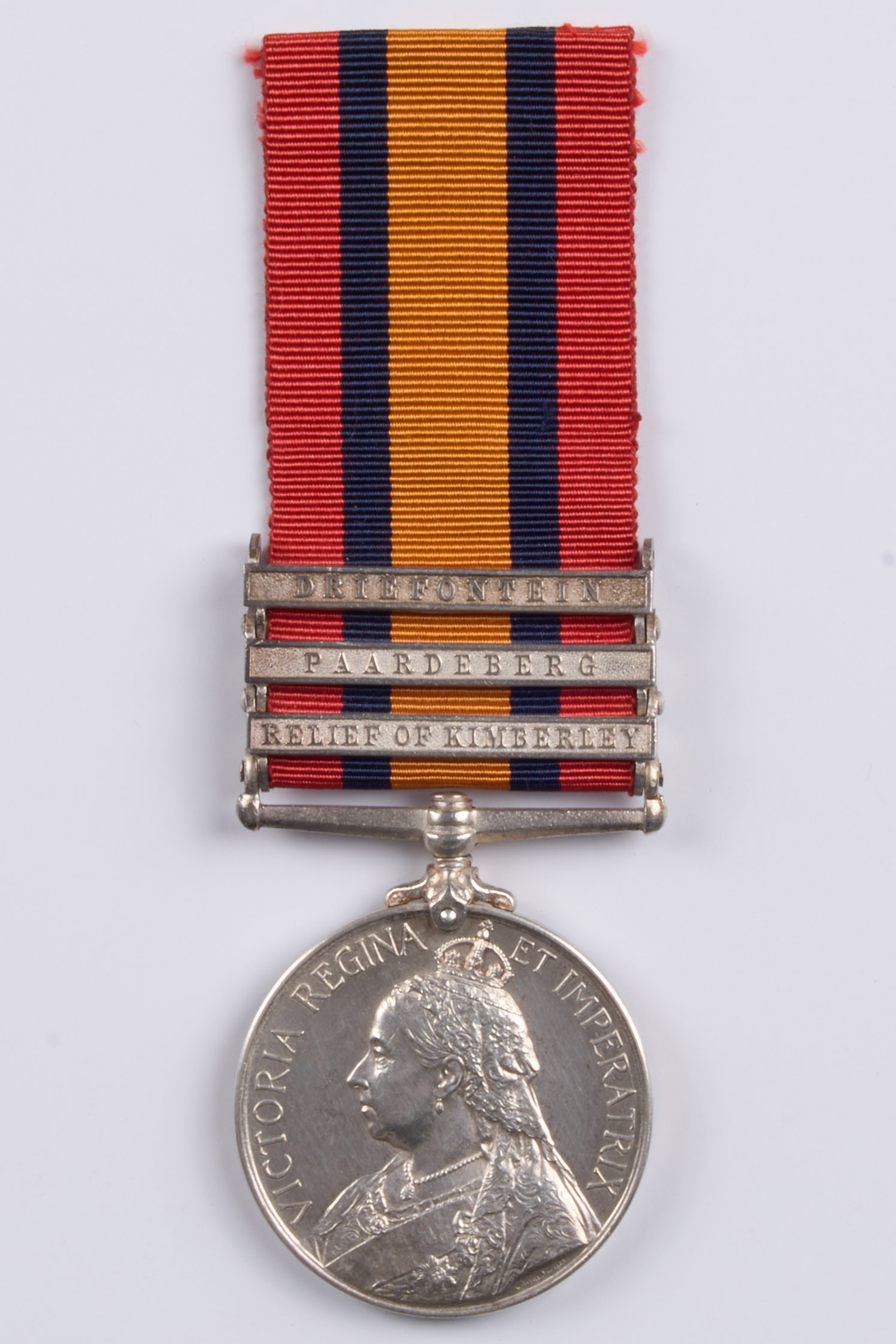
The Queen’s South Africa Medal awarded to Private Jabez Ballard, 2nd Battalion The Buffs (east Kent Regiment) who was Killed in Action on the 10th of March 1900 at Driefontein comprising Queen’s South Africa Medal, 1899-1902, 2nd type, three clasps, Relief of Kimberley, Paarderberg, Driefontein, (2389 Pte J. Ballard, E. Kent Regt) impressed naming but the medal was the wrong way around when impressed, very fine(1)
The 2nd Battalion sailed on the Gaika on 22nd December 1899 and arrived at the Cape on 13th January. Along with the 2nd Gloucesters, 1st West Riding-Regiment, and 1st Oxford Light Infantry, they formed part of the 13th Brigade under Major General C E Knox, and part of the VIth Division under General Kelly-Kenny.
In February, after a short sojourn in Cape Colony, the 13th Brigade accompanied General Kelly-Kenny to Modder River. His other original brigade, the 12th, was left in the Colesberg district, and one known as the 18th, under Major - General T E Stephenson, was substituted in the VIth Division for it.
The VIth Division and their commander played a prominent and distinguished part in Lord Roberts' first great move, and the earlier part of their doings is most clearly, yet modestly, set out in General Kelly-Kenny's despatch of 20th February 1900. The division left Enslin on 12th February and moved southeast to Ramdan. On the 13th they started at dawn, marching to Waterval Drift on the Riet. On the 14th they marched to Wegdrai Drift, and again the same evening, starting at five o'clock, they marched to Klip Drift on the Modder, where they arrived at 1 am on the 15th. On the 16th Cronje's column was sighted, attacked, and harassed. On that day the Buffs had some stiff fighting. On the 17th at 3 am the pursuit was continued with only a short rest, till the vicinity of Paardeberg and Cronje's camp was reached at 9 pm On the 18th another start at 3 AM, and touch with the enemy's main body was had at 7 am According to unofficial accounts this hour might be somewhat earlier. Cronje was laagered in the hollow of the Modder. The 18th Brigade under Stephenson was thrown out to the south-east of the Boer position, the 13th Brigade to the south, while the Highland Brigade, part of General Colvile's IXth Division, which joined the action early in the day, attacked from the south-west and west sides. Across the river, roughly north-west of the Boer position, Colville's other brigade, the 19th, under Smith-Dorrien, operated, while some of French's cavalry were able to assist in containing the enemy on the north and north-east. Indeed Broad-wood had headed Cronje on the 17th. The part of the cavalry in heading Cronje is sketched under the Household Cavalry Regiment. The battle on the 18th was a bloody one, which "continued the whole day, the troops pressing the attack on both flanks, but meeting very stubborn opposition". Although at nightfall the enemy still held on to his intrenchments, he was completely hemmed in on all sides, with his laager, waggons, and ammunition destroyed. In the course of the battle General Knox was wounded, as was also General Macdonald. The Buffs' losses on the 18th were not severe.
On the 20th the Buffs, acting in concert with the 1st Yorkshire Regiment, captured 80 prisoners, a part of those bodies of Boers who came up to look on at Cronje's plight; else they did not or could not do. Cronje surrendered on the 27th, and the army moved eastward.
On 7th March was fought the battle of Poplars Grove, rather a disappointing fight, except that the Boers fled incontinently, notwithstanding the presence and objurgations of the two Presidents. The VIth Division had again a principal part to play, but "made too wide a detour to the south, result being that before it approached the seven kopjes the enemy had been dislodged by the Horse Artillery fire in reverse, coupled with the well-aimed shell-fire of the 4'7-inch naval guns in front".
On the 8th and 9th March the bulk of Lord Roberts' force halted at Poplars Grove, but on the 9th the Vlth Division and the 1st Cavalry Brigade moved eastward eight miles. On the 10th was fought the battle of Driefontein, or Abraham's Kraal. In his despatch of 15th March Lord Roberts details the instructions he issued for the advance of his army in three columns on Driefontein. He then states: —
"On the 10th the movement was begun as ordered, and the right column occupied Petrusburg without opposition. The left column found the enemy holding several kopjes behind Abraham's Kraal and endeavoured to turn their left flank by moving to the south. The Boers, however, anticipated this manoeuvre by a rapid march southward, and took up a fresh position on a ridge about four miles long, running north and south across the road two miles east of Driefontein. Lieutenant General French followed up the enemy with the 1st Cavalry Brigade and the Vlth Division and came into contact with them at 11 AM.
"Meanwhile the 2nd Cavalry Brigade had reached Driefontein, and endeavoured, in conjunction with the 1st Cavalry Brigade, to turn the rear of the Boers by operating in the plain behind the ridge which they were holding. The enemy's guns, however, had a longer range than our field-guns, which were the only ones immediately available, and some time elapsed before the former could be silenced, especially a Creusot gun, which had been placed in a commanding position on an isolated kopje two and a half miles east of the northern end of the ridge. The infantry of the Vlth Division reached this end of the ridge about 2 PM, having been under the enemy's shellfire, which did but little damage, for more than an hour. The Boers were gradually pushed back towards the centre of the ridge, where they made an obstinate stand.
"The IXth Division came up at 5 PM, and I at once ordered the Guards Brigade and the 19th Brigade to the assistance of the Vlth Division; but before these reinforcements could reach the ridge, the enemy's position was stormed in the most gallant manner by the 1st Battalions of the Essex and Welsh Regiments, supported by the 2nd Battalion of the Buffs. The bodies of 102 Boers were afterwards found along the ridge, mainly in the position which they held to the last. Many of their horses were killed".
On the 10th the Buffs had 1 officer and 20 men killed; 2 officers, including Colonel Hickson, and 70 men wounded.
Sold with Copy Medal Roll confirming the three clasps, he is also entitled to the India Medal, 1895-1902 with the clasp Relief of Chitral.