
Lot 106
Died of Wounds Received in Action at Diamond Hill ‡
Clandestine Operations - Inc The D.J. Croll Medal Collection & Other Properties | M26002
Auction: 16 September 2026 at 10.30 BST
Description
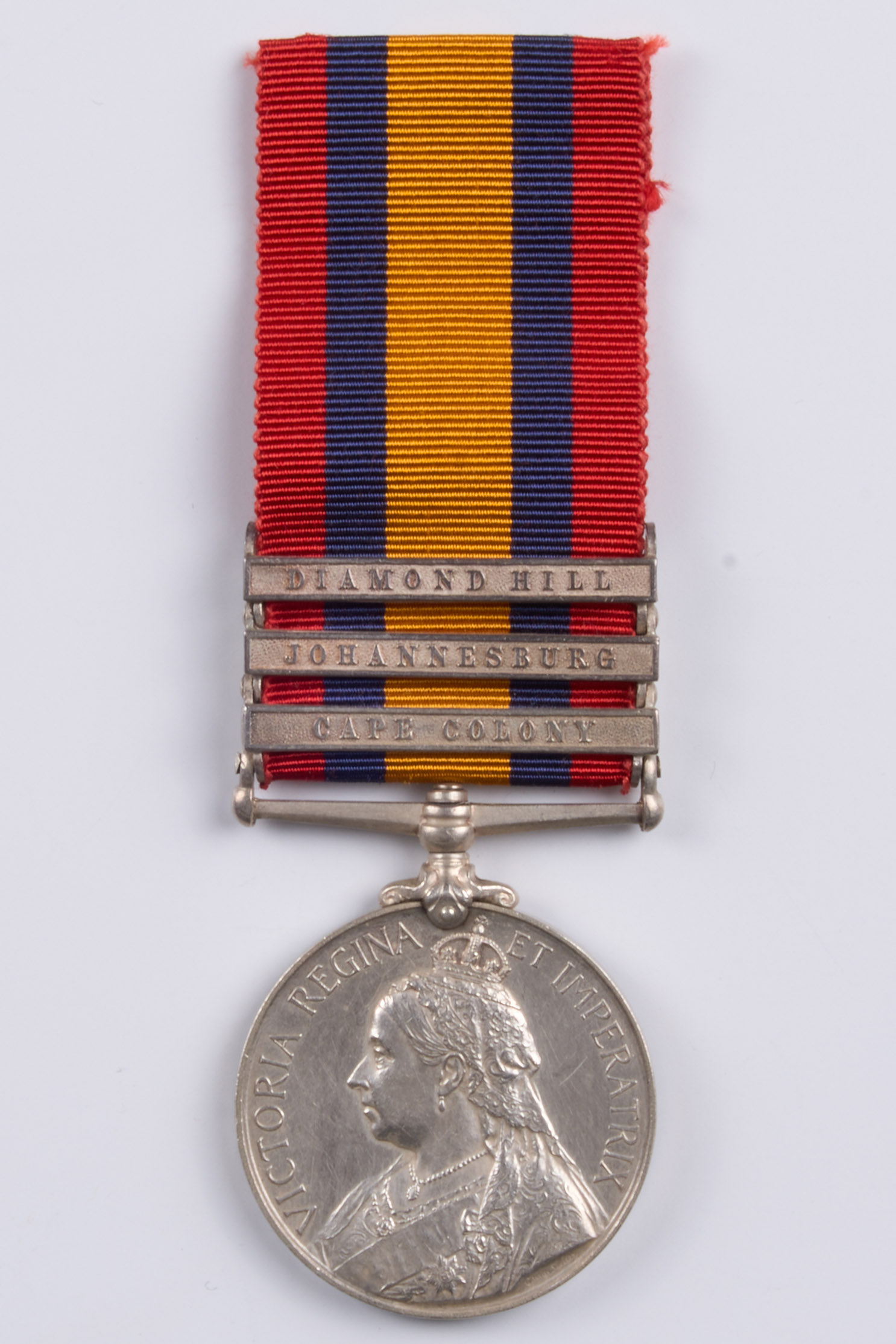
The Queen’s South Africa Medal awarded to Private A. Otway, 5th Lancers who Died on the 11th of June 1900 from Wounds Received in Action at Diamond Hill comprising, Queen’s South Africa Medal, 1899-1902, 3rd Type, three clasps, Cape Colony, Johannesburg, Diamond Hill, (4212 Pte A. Otway. 5th Lancers.), edge knock under serial number but number not affected, otherwise impressed naming very fine (1)
Diamond Hill
After the capture of Pretoria Ian Hamilton's Infantry Division was broken up, Smith-Dorrien's brigade being needed on the line between Kroonstad and the capital; the 21st, however, remained under the two Hamiltons, and at Diamond Hill had the most prolonged fighting they had seen. The successes of De Wet and the Free State Boers against the lines of communication had encouraged the Transvaalers to close in on the east of Pretoria, and it became necessary to drive them off. On 11th June the position roughly was—French with two Cavalry Brigades, or what was left of them, was on the left; Pole-Carew with the Guards and Stephenson's 18th Brigade in the centre and left centre; the 21st Brigade on the right centre; and Broadwood's and Gordon's cavalry brigades on the right. The position could not be turned, and the mounted men could no more than hold their ground. Mr Churchill in his excellent account of the battle says: "Ian Hamilton directed Bruce Hamilton to advance with the 21st Brigade. This officer, bold both as a man and as a general, immediately set his Battalions in motion. The enemy occupied a long scrub-covered rocky ridge below the main line of hills and were in considerable force. Both batteries of artillery and the two 5-inch guns came into action about two o'clock. The Sussex Regiment, moving forward, established themselves on the northern end of the ridge, which was well prepared by shelling; and while the City Imperial Volunteers and some parts of the mounted Infantry, including the corps of guides, held them in front, gradually pressed them out of it by rolling up their right. There is no doubt that our infantry have profited by the lessons of this war. The widely extended lines of skirmishers moving forward, almost invisible against the brown grass of the plain, and taking advantage of every scrap of cover, presented no target to the Boer fire. And once they had gained the right of the ridge it was very difficult for the enemy to remain. Accordingly at 3.30 the Boers in twenties and thirties began to abandon their position. Before they could reach the main hill, however, they had to cross a patch of open ground, and in so doing they were exposed to a heavy rifle-fire at 1200 yards from the troops who were holding the front".
Shown on Medal Roll as 4212 Pte A. Otway Deceased.
Shown in The Boer War Casualty Roll 1899-1902 by Alexander M Parker as 4212 G. Ottoway shown in Effects Register as 4212 5th Lancers Otway. With the initials R and F crossed through and they settled for H!
Sold with Copy Medal Roll confirming the 3 clasps.