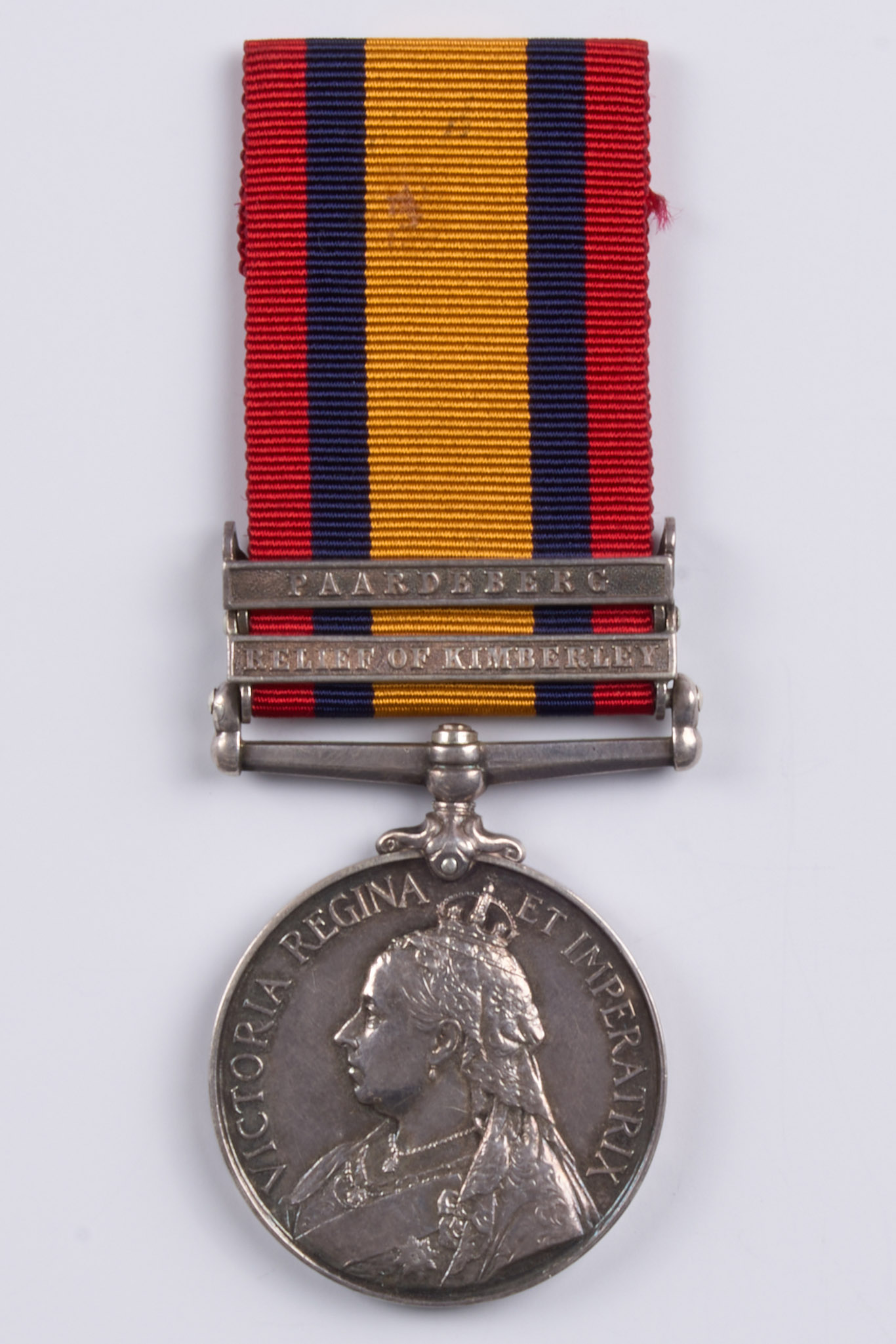

Lot 104
Wounded -Paarderberg 23rd February 1900 ‡
Clandestine Operations - Inc The D.J. Croll Medal Collection & Other Properties | M26002
Auction: 16 September 2026 at 10.30 BST
Description
The Queen’s South Africa Medal awarded to Private J. Harwood 1st Battalion Prince of Wales Own Yorkshire Regiment who was Wounded at Paarderberg 23rd of February 1900 comprising, Queen’s South Africa Medal, 1899-1902, 2nd type, Ghost Dates, two clasps, Relief of Kimberley, Paarderberg, (5719 Pte A. Harwood, Yorkshire Regt), impressed naming lightly toned very fine (1)
The 1st Battalion Yorkshire Regiment sailed on the Doune Castle about 24th of November 1899 and arrived at the Cape about the 15th of December.
The 1st Battalion the Yorkshire Regiment went out as part of Sir Charles Warren's Vth Division, but while Sir Charles with six of his Battalions went on to Natal, the 2nd Warwicks and 1st Yorkshire were dropped at Cape Town, and this Battalion went up to the Colesberg district to help General French in his efforts to repel the Boer invasion of the colony.
The force under General French was largely a cavalry one, but he had fortunately some fine infantry, including four companies of the 2nd Berkshire, who had been in South Africa when the war broke out, the 1st Welsh, who arrived about 22nd November, and the 1st Essex, who arrived early in December; later he got the Suffolks, and then the Wiltshire’s and other regiments of the Vlth Division. While the din of Magersfontein, Colenso, and Spion Kop was in our ears we had little thought of the splendid work French was doing with a very slender force, but the events of the intervening years have taught us the inestimable value of that work. Had the enemy passed Naauwpoort, De Aar with its millions' worth of stores would have been at his mercy, Lord Methuen's communications would have been cut, and an advance by the Kimberley line made almost impossible.
The 1st Yorkshire had done their work in the Colesberg district without mistake, and when Lord Roberts in the beginning of February 1900 was making up a force for his great effort, the Battalion, along with the 1st Essex and 1st Welsh, was taken to Modder River and there put into the 18th Brigade under Brigadier General T Stephenson, who at the time of his appointment was colonel of the 1st Essex. The other Battalion was the 2nd Warwicks, which was then employed in the Britstown neighbourhood, and unfortunately did not join the brigade in time to take part in the triumph of Paardeberg. Evidently Lord Roberts desired to have in his force as many seasoned Battalions as possible, as the 18th Brigade took the place of the 12th in the Vlth Division under Lieutenant General Kelly - Kenny, the 12th being left under General Clements in the Colesberg district, where most of the troops of the 18th had just been.
The work of the Vlth Division while acting together in the eastern advance has been sketched under the East Kent Regiment. Of that work the 1st Yorkshire took their share, as is proved by their losses. At Paardeberg on 18th February they had 1 officer and 30 men killed, 4 officers, including Colonel Bowles and Major Kirkpatrick, and over 100 men wounded. The heaviest regimental loss in that battle was that of the Seaforths, 33 killed, the Canadians and Welsh having about 20 each.
On the 20th the 1st Yorkshire again distinguished themselves in actions against parties of Boers who came to Cronje's assistance, they and the Buffs taking 80 prisoners. On the 23rd they were in a stiff fight and did very well. On 10th March at Driefontein the 18th Brigade were in the front and had again very hard fighting. The East Kent, Welsh, and Essex were first line, the 1st Yorkshire and 2nd Gloucesters supporting. Late in the afternoon the bayonet had to be used to clear the position. This Battalion on the 10th lost 3 killed and 23 wounded. Three officers and 2 non-commissioned officers were mentioned in Lord Roberts' despatch of 31st March 1900.
A koppie in the Orange Free State (Petrusburg district; Free State), 50 km south-east of Kimberley. Variant: Oskoppies (name used by Breytenbach, presumably because the koppies were situated on the farm Osfontein). The koppie commands the Modder River and the plain on either side of it and thus was an important feature of the battle of Paardeberg. Early on the morning of 18 February 1900, Col O.C. Hannay moving eastwards left the 4th mounted infantry regiment and a squadron of Kitchener's Horse at the koppie. Late in the afternoon the koppie and the neighbouring farmhouse of Osfontein were still held by Kitchener's Horse, but some of Veg-Gen C.R. de Wet's commando under Asst Veg-Gen P.R. Botha attacked and successfully held the koppie and Osfontein and Stinkfontein farmhouses. The koppie was attacked by part of Maj-Gen J.D.P. French's cavalry division on 21 February and by Maj-Gen Sir H.C. Chermside's 14th infantry brigade; de Wet, feeling that he was surrounded, withdrew. Field-Cornet T. Spiller of Wepener and 45 burghers who had not retired from the koppie eventually surrendered to men of the 2nd The Lincolnshire regiment. De Wet tried unsuccessfully to retake the koppie on 23 February, an action in which Cmdt H. Theunissen and some 80 burghers of the Winburg commando were taken prisoner.
Sold with Copy Casualties in the Boer War entry, Copy Records of Deceased Soldiers Effects, Copy Medal Roll confirming both clasps. The Medal Was returned to the Medal Office in 1908 and Re-Issued on the 14th of March 1912