
Lot 144
The Outstanding 1st July 1916 Manchester Pals Attack on Guilemont DSO
At Sea, On Land & In The Air | M24003
Auction: 24 September 2024 at 18:30 BST
Description
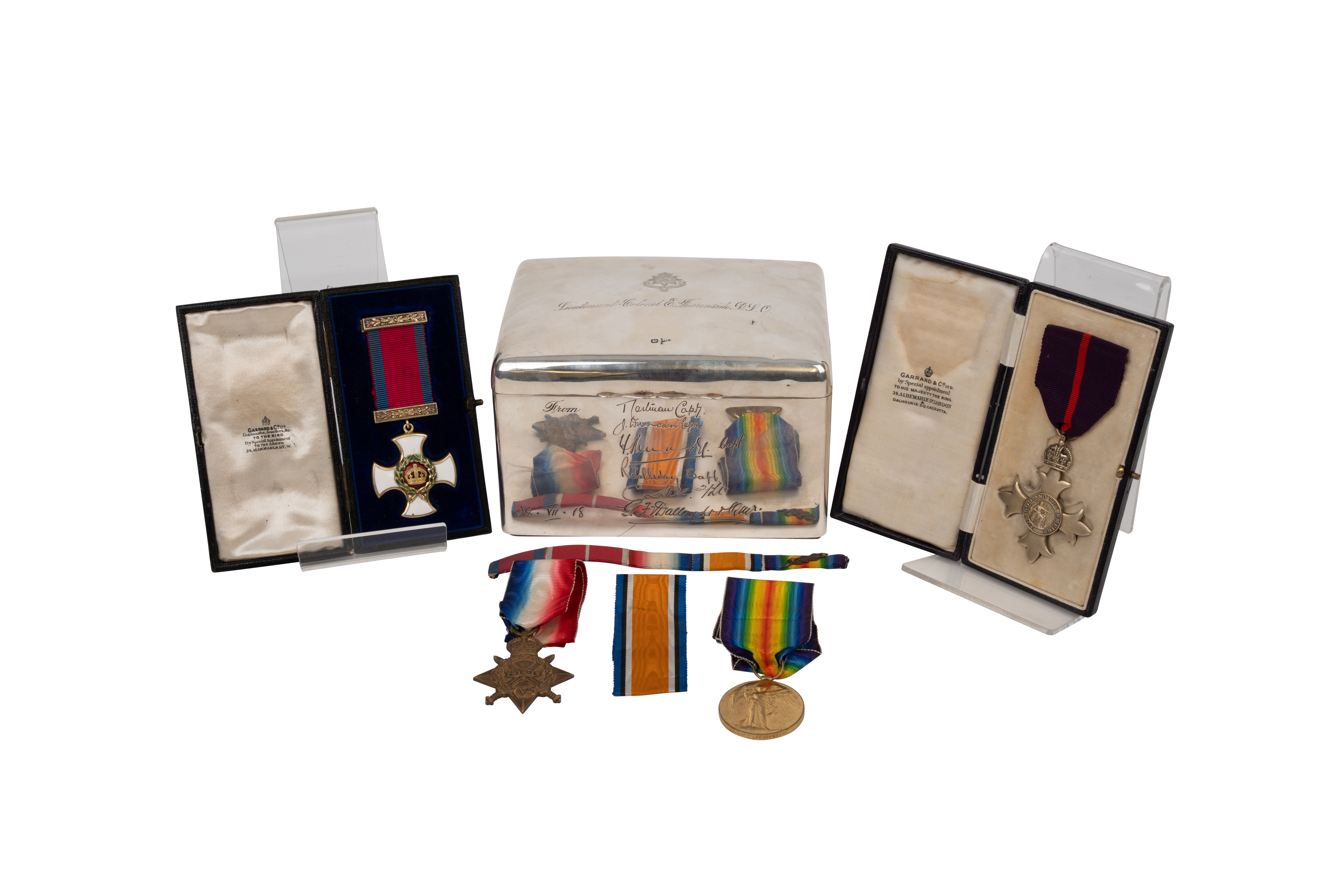
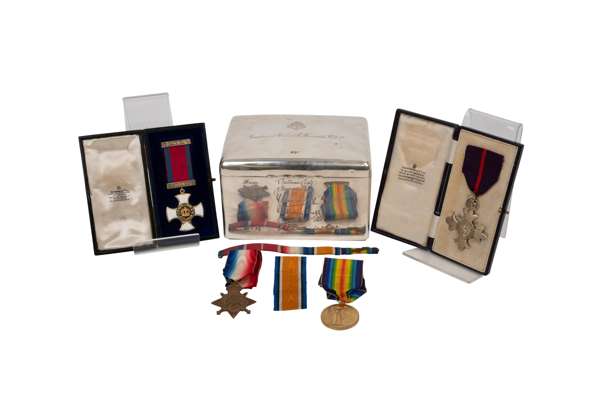
The Outstanding Distinguished Service Order awarded to Captain, later Lieutenant Colonel, Edmund Fearenside, “A” Company, 17th (Service) Battalion (2nd City) Manchester Regiment, the family history has stated Montauban, but further research has shown that the DSO was awarded for the Battalion Attack on Guilemont on the 30th July 1916, WO 389/2/1 ref. comprising, Distinguished Service Order, GVR, unnamed as issued, Officer of the Most Excellent Order of the British Empire, O.B.E. (Mily), hallmarked London 1919, 1914-15 Star, (Capt. E. Fearnside Manch. R.), 1914-1919 Victory Medal, (Lt. Col. E. Fearnside.), note British War Medal is missing from Group, very fine (4)
DSO The London Gazette 26th September 1916
Temporary Captain Edmund Fearenside, Manchester Regiment
“For conspicuous gallantry in action. He led up to two companies of reinforcements over some 1,800 yards of open ground swept by machine gun fire, into a village. Here he rallied his men and organised a further attack. He displayed the greatest coolness and courage throughout”.
OBE The London Gazette 3rd June 1919
Fearenside, Maj. (T./Lt. Col.) Edmund, D.S.O, Manc, R,
Edmund Fearenside was born on the 2nd June 1881 in the Market town of Burton, near Kendal in the County of Westmorland (Now Cumbria).
The Son of Thomas Charles, a local coal, wine and spirit merchant and Mary Ann Fearenside, Edmund had an older Brother Harold born in 1880.
Edmunds Father died 6 Months after he was born and when he was 6, His Mother died in 1887 aged 36 Years. Edmund went to live with his Fathers Brother, William at 44, Hartingham Road, Toxteth Park, Liverpool. In 1889 aged 9, Edmund was sent to Ellesmere College in Shropshire and stayed until 1898 when he was awarded a Wakeman scholarship to Denstone College in Uttoxeter Shropshire, where he studied the classics.
He was a fine Cricketer and an excellent Rugby player and took the lead in many of the School plays.
“Ted” as he was affectionately known carried off many of the School prizes and it was no surprise when in 1900 he won an open scholarship to queens College, Oxford. Ted was an Oxford rugby blue and first reserve for the England team including the 1906 game against the New Zealand All Blacks. In 1902 Edmund gained a Second Class Classical Honours Degree and in, 1904 a Second Class Literature Degree.
From 1903-1904 he was a member of Harlequins rugby club and a Cheshire County Rugby XV.
In 1905, Edmund Fearenside took up the post of classics master at Merchiston Castle School, Edinburgh and was still there at the outbreak of war in August 1914.
(Another ex-Master of Merchiston was Wilfrith Elstob who was later to command the 16th Battalion and go on to win a Victoria Cross for his actions at Manchester Hill in 1918).
Edmund had had only 50 hours previous Military Experience with the Edinburgh University Officer Training Corp but he Volunteered for service and on the 19th September 1914 he was commissioned as a Second Lieutenant in the 17th (Service) Battalion of The Manchester Regiment.
The 17th Manchester’s were a “Pals” Battalion raised amongst the City’s clerks and warehousemen in a welter of patriotic fervour and indignation at Germany’s invasion of Belgium and perceived threat to the British Empire. These were Men of little or no military experience and Officers with leadership potential were desperately needed-men such as Edmund Fearenside.
The small, but highly trained peacetime British Army were despatched to Belgium straight away and old Officers and soldiers were brought out of retirement to train the new armies for service. Training commenced in and around the City and the Men were billeted at Heaton Park, a large open Public space on the outskirts of Manchester. The Officers were usually trained by the Adjutant-a regular officer attached to the Battalion-In the case of the 17th Battalion, Captain Charles McDonald.
On the 19th December 1914 Lieutenant Fearenside was promoted to Temporary Captain and was appointed the Second in Command of A company.
On the 24th April 1915 the Battalion moved to Belton Park near Grantham and on the 7th September to Lark Hill on Salisbury Plain.
On the 8th November 1915, Captain Fearenside and the 17th Battalion left Folkestone for Boulogne and Military service in France. In the July battles of the Somme, Captain Fearenside was awarded the Distinguished Service Order for his part in the assault on Guilemont on the 30th July 1916. His Citation published in the London Gazette of 26th September reads:
Temporary Captain Edmund Fearenside, Manchester Regiment
“For conspicuous gallantry in action. He led up to two companies of reinforcements over some 1,800 yards of open ground swept by machine gun fire, into a village. Here he rallied his men and organised a further attack. He displayed the greatest coolness and courage throughout”.
On the 13th October 1916 Captain Fearenside proceeded to England to attend a Commanding Officers course in Aldershot, returning to the Battalion on the 6th January 1917.
On the 7th January 1917 Captain Fearenside DSO took command of A Company. On the 23rd he was appointed Battalion second in Command.
On several occasions during His service Captain Fearenside assumed command of the Battalion and apart from a brief posting to Brigade Headquarters he spent the whole of the war with them. He returned to England in August 1918 and ended his Military career as an Acting Lieutenant Colonel Commanding the 14th South Lancashire Regiment.
On the 3rd June 1919 he was appointed an Officer in the order of the British Empire (Class IV), Military Division.
On the 15th July 1919 he relinquished the acting rank of Lieutenant Colonel and was finally released from Military Service on the 16th July 1919.
Edmund Fearenside returned to Merchiston Castle School in Edinburgh and remained there until his retirement in 1935. During the Second World War he returned to teaching as a Master at St Edwards School in Oxford, finishing in 1946.
His address was given as 10, Woodstock close, Oxford and he was a Member of the Clarendon Gentleman’s club in Oxford. Edmund Fearenside DSO, OBE died, after a long illness on the 2nd October 1959 in an Oxford Hospital aged 78.
Sold with Copy Medal Index Card, Copy London Gazette entries, he appears in the Manchester City Battalions Book of Honour 1914-18, Two Copy Photographs in uniform, His Officer Papers are held at the National and OBE are in their Garrad & Co Cases of issue. The Medals are housed in a solid silver cigarette case autographed by many officers a presentation to Lt Col Fearnside DSO date 28th of August 1918.