
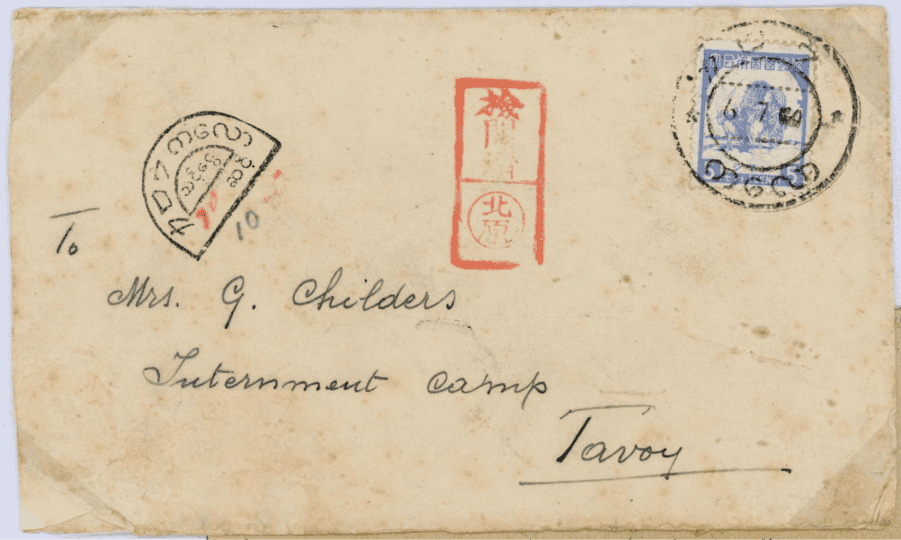
Sometimes as a philatelist, an item crosses your desk of such interest and importance that the story it tells is fascinating to a far wider audience than specialists of the area in question. This Burma Japanese Occupation cover is one such item.
The cover was sent from Kalaw, a hill town in the Shan States of what is now Myanmar, a place where the temperate climate and fertile soils drew interest from the British even in the earliest days of colonial Burma. Sir Hubert Thirkell White visited by horse in the 1890s and wrote that it was “a perfectly lovely spot, believed by many to be the future hill capital of Burma.” Visiting in 1912, P.D Patel described it a “a real health resort” and an editorial in The Rangoon Times referred to it as “the Rhodesia of Burma”. Even today, there is a smattering of colonial architecture remaining, including the much-loved red brick railway station which “might as well have been plucked straight out of an English village.” The idyllic peace and tranquillity of the town was shattered by the invasion of the Japanese, and that is where the story of this cover begins.
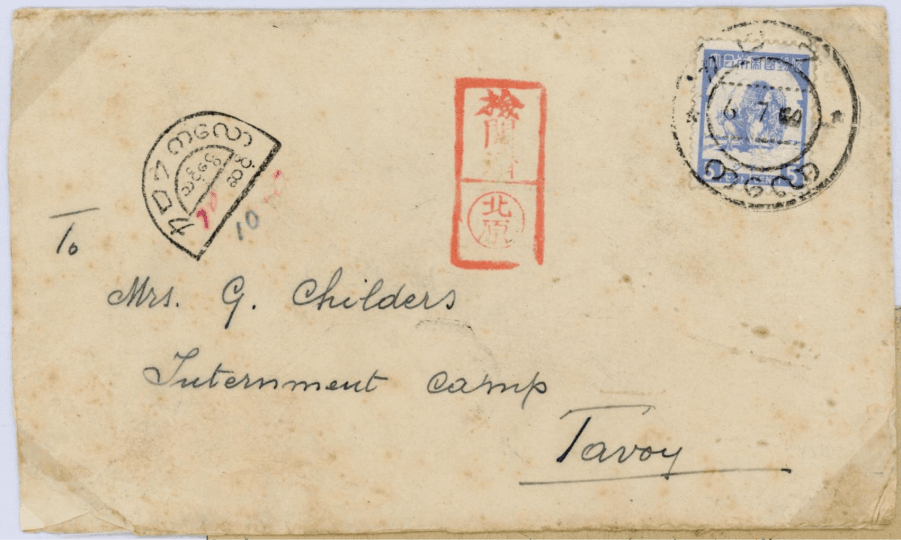
The cover is addressed to 'Mrs G. Childers, Internment Camp, Tavoy'. Even forgetting that this is a commercial usage of an occupation Shan States stamp and thus of the highest rarity, it is even more remarkable as only around 200 British and Indian civilians were left in Burma after the chaotic evacuation of the territory as the Japanese approached in 1942.
I have built up a habit of researching the names of the name of recipients of covers in my care, but seldom have I ever hit the jackpot of uncovering such an interesting story as Mrs Childers. Credit for the below information provided belongs to Sampan travel who arrange tours of Kalaw.
Gladys Mary Childers had the misfortune of ending up in the internment camp for the duration of the war after the plane in which she was attempting to leave crashed, killing her niece. She was forced to return to Kalaw on foot, where Maureen Baird-Murray, then an eight-year-old Anglo-Burmese in the care of Italian nuns, remembers Mrs Childers turning up at St Agnes Convent injured and bedraggled. Mrs Childers hid for several months with the nuns before she was discovered by the Japanese and seized. “The Mother Superior reached out to her to show that the nuns were not guilty of betrayal “but one of the soldiers butted her away with his rifle as a warning. We felt the brave lady understood, as with bloody head held high, she was marched away.”
Her biography paints a fascinating picture of life in Colonial Burma: “Mrs Childers was already a widow. She and her husband Lt-Col Hugh Francis Eardley Childers had lived in a grand house in Kalaw (still marked as ‘Mrs Childers’s House’ on most tourist maps of the town). They were known to keep elevated social standards. In the evening, he would always wear a dinner jacket and she an evening gown with gloves. Mrs Childers returned to Kalaw after the war where she entertained girls from the convent with cucumber sandwiches and tea from a silver pot. She couldn’t speak a word of Burmese and would insist, “If you are not understood in English, you shout!”
The charming story had a slightly sad ending which I hope would never be allowed to happen today- “When Mrs Childers died, she left her house to her Indian driver. This was a scandal and the house was later confiscated.”
In any case the cover is a wonderful piece of tangible World War Two history, which no doubt owes its survival to the fact that at one stage it contained a letter from her hometown that Mrs Childers clearly treasured for the duration of the war. The envelope passed into the great Gerald Davis collection of Burma and only after eighty years has the full story been pieced together.
The cover goes under the hammer at Stanley Gibbons Baldwins on the 31st March, as part of our “Stamps and Covers of Asia & the Middle East” auction, sale number S26007 Lot number 54.
For more information or for additional scans of the item contact George James on gjames@stanleygibbons.com