
Lot 113
Wounded in Action at Sannah’s Post 31st of March 1900 and Died of Wounds 2 Days later ‡
Clandestine Operations - Inc The D.J. Croll Medal Collection & Other Properties | M26002
Auction: 16 September 2026 at 10.30 BST
Description
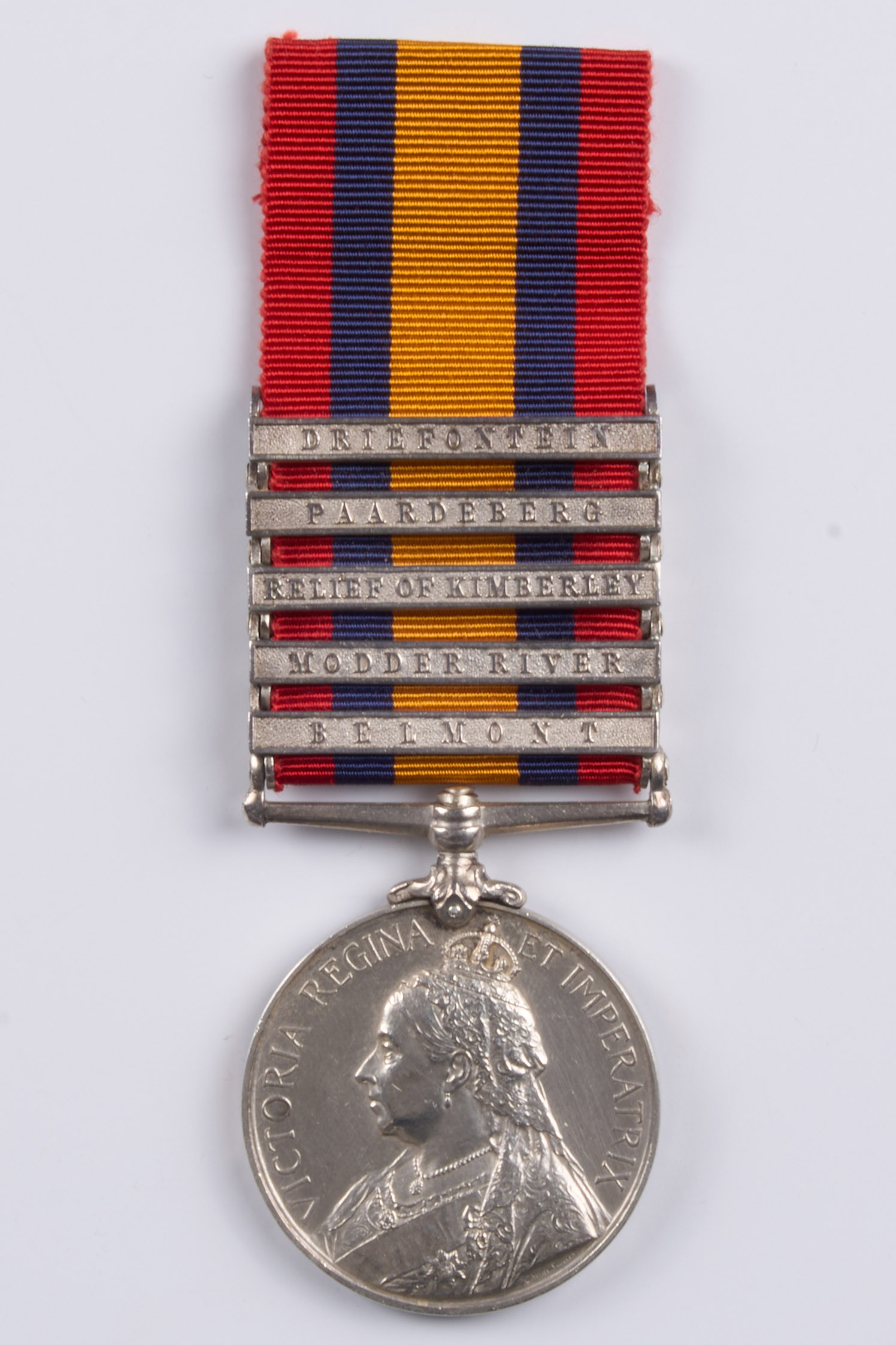
The Queen’s South Africa Medal awarded to Private H Sinclair, 1st Battalion Northumberland Fusiliers, who was Wounded in Action at Sannah’s Post on the 31st of March 1900 and Died of Wounds on the 2nd of April 1900 comprising Queen’s South Africa Medal, 5 clasps: Belmont, Modder River, Relief of Kimberley, Paardeburg and Driefontein (4439 Pte H. Sinclair, North’d: Fus:) impressed naming, very fine (1)
The Action at Sannah’s Post Kornspruit
During the darkness De Wet infiltrated a force of riflemen into the ravine created by the Modder River, setting the kill zone of the ambush. At first light on 31 March, Piet de Wet's artillery opened fire from a set of small hills to the north as the British troops were striking camp for the morning. Tactical surprise was complete and all were sent into a state of confusion. The British force began to retreat as expected, in the direction of the ravine where the blocking force awaited with orders from De Wet to hold their fire. The civilian wagon drivers preceding the soldiers were seized by the Boers and told if they warned the British, they would be shot. Therefore, the British soldiers suspected nothing and approached the river in small groups. As they did so De Wet’s troops ordered them to surrender, and approximately two hundred were captured, along with the six guns of U Battery.
An alert British officer noticed what was happening and ordered Q Battery to gallop away. De Wet's men then opened fire. The British fell back on a railway station which offered substantial cover, while Q Battery under Major Phipps-Hornby (joined by one gun from U Battery whose team managed to break away from de Wet) deployed in the open and opened fire.
This fire, combined with accurate rifle fire from the railway station, pinned down Christiaan de Wet's men, but Piet de Wet's forces were increasing their pressure. Broadwood's ammunition was running out, and he decided to retire to the south. His guns had first to be recovered. Five were hooked up and towed away, but two had to be abandoned. Many British soldiers were killed crossing the 1300 yards of open ground to retrieve the guns, but unit integrity was maintained.
Eventually, Broadwood managed to break contact. Approximately three hours later the 9th Infantry Division commanded by Major General Sir Henry Colville arrived to relieve the mounted brigade, but de Wet’s men had withdrawn to highly defensible positions across the Modder River and both sides retired from the field. This nevertheless left Bloemfontein's water works in Boer hands.
In all, the British suffered 155 men killed or wounded. 428 men, seven field artillery pieces and 117 wagons were captured. The Boer force suffered three killed and five wounded. But even more serious than the losses in the action was the loss of Bloemfontein's water supplies. This greatly aggravated an epidemic of enteric fever dysentery and cholera among the occupying British army, which eventually caused 2000 deaths.
Sold with copy Medal roll confirming all 5 clasps, and Corporal Sinclair is also entitled to the Queen’s Sudan Medal and the Khedives Sudan Medal with the clasp Khartoum.