
Lot 224
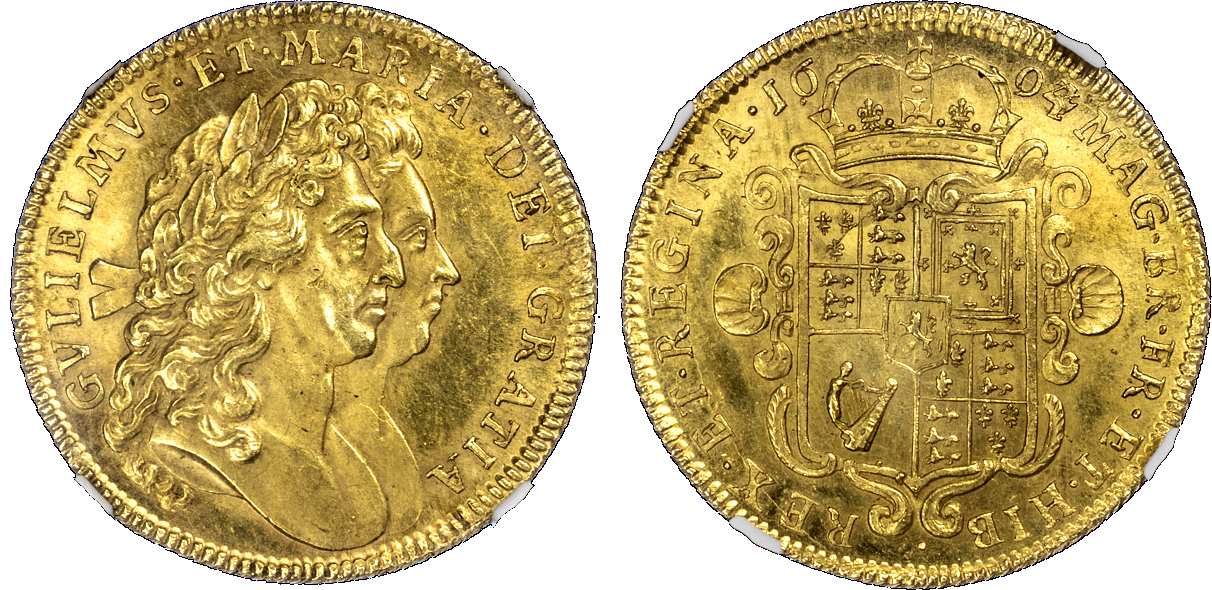
William and Mary (1689‑94), Two Guineas, 1694/3 conjoined busts right, NGC MS63
Ancient, British and World Coins - 114 | C24002
Auction: 7 March 2024 at 10:00 GMT
Estimate: £50,000 - £60,000
Description
William and Mary (1689‑94), Two Guineas, 1694/3 conjoined busts right, toothed borders both sides, legend surrounding, GVLIELMVS ET MARIA DEI GRATIA. Rev, crowned quartered shield of arms with scalloped frame, date either side of crown, reads MAG BR FR ET HIB REX ET REGINA (S.3424; MCE 146; cf. Schneider II, 463/464; ). An exceptional example with an extraordinary level of detail and precision, in both the obverse conjoined busts and reverse quartered shield. Tiny nick in portrait, otherwise much as struck. Lustrous satiny toning, a combination of amber like gold displaying the underlying mint bloom, closer to a proof coin that a currency type, reverse fleur de coin. One of the finest examples available for commerce, encapsulated and graded by NGC as Mint state 63, rare so well preserved.
Footnote
The Two Guinea series for William & Mary are realistically a two year type covering 1693 and 1694, with the 1694/3 [struck over three] offered with or without elephant and castle below. The 1691 is seldom seen, classed as extremely [excessively would be more realistic] rare in supporting price guides, and almost stands outside of the series, in real terms. Featuring the only conjoined busts in British milled coinage, the reverse quartered shield of arms both elaborate and complex, paying homage to each ruling house. The joint monarchs are known for issuing very little Gold between 1689‑94, it has been said by other specialists that the dies were most probably shared between the aforementioned years; with the obverse die re‑engraved for the 1694 issue. [cf., ‘The Millenia Collection’ 26th May 2008, lot 344, Auction 46 – Goldberg Coins and Collectibles].Our example on offer is one of a select handful of this year and type which scores so highly in its grade and preservation (see, the Millenia example, Hayleigh collection piece and Spink 12th November 2003, lot 35 for comparative studies). It has also been argued by several collectors and auction houses that the Two Guinea denomination is played down as it sits in between the Guinea and Five Guinea types. As time passes on, the cataloguer feels the momentum will swing in their favour. In numismatic circles they have always been a respected series, in the rarest proof, presentation style strikes they hammer as high as any other type coin. Only a few months back a 1768 Two Guinea proof by J. S. Tanner hammered for $320,000 without premium. Our example Two Guinea, is not only exceptional in its strike and tone, it joins a small exclusive group of top tier pieces for the date of issue in the reign of William of Orange and Mary Stuart. Graded as one of the finest known, superb, with immense eye appeal. A complete coin struck with authority, displaying the trademark excellence of James and Norbert Roettier, the engraver‑designers. Incidentally, this may have been Norbert’s last work on British soil as he moved to France in 1695.