
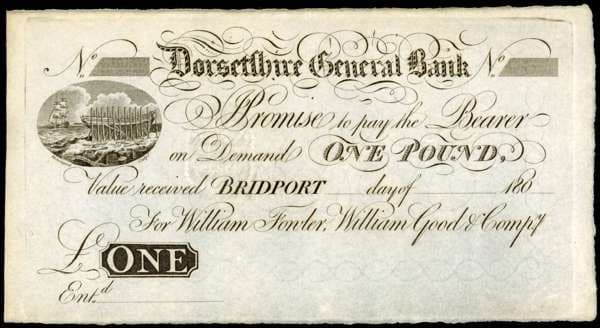
One of the more interesting and stronger sections of banknotes being sold by Baldwins at their banknote auction on the 29th. of January, are British Provincial banknotes. Apart from a very good private collection of Provincial British banknotes sold at the beginning of the sale (lots 47 to 112), there is a very good selection from Baldwins Basement, (lots 131 to 168).
The provincial private banks of England provided the invaluable function of supporting and promoting the Industrial Revolution. The Bank of England really confined itself to the City of London and with very little exception, never established any branches outside of the capital.
In order to protect the Bank of England from competition a provincial bank’s size was limited to six partners and really, they provided the emerging business and industrial enterprises with what we would call today ‘financial services’. However, these were banking services under artificial constraints and consequently there were many failures - as can be seen in the many banknotes here with bankruptcy dividend stamps and inked dividend notices.
Many provincial banks prospered for long periods and household banking names such as Lloyds partially evolved from Gloucester and Stafford banks in its past, as did Nat. West from Derby, Dover and Nottingham banks.
In the latter half of the 19th. century these private banks that were left became part of the joint stock movement and established themselves within the modern banking institutions in which we are familiar today.
Each provincial bank could issue its own banknotes, although legislation in 1777 prohibited banknotes under £5. - but in 1797 this was reduced to £1 or 1 guinea due to the financial strains of the war with France. After the French were defeated, this was raised to £5 in 1825 and no lower denominations were issued until the next century. In 1844 there were 442 different banks operating in England and Wales and at that point it was legislated then that no more private banks could be set up.
Eventually at the end of the 19th. century the major banking firms, through amalgamation and consolidation, came to dominate, ultimately leaving the banking names of Barclays, Midland, Lloyds and Nat. West. that we all know and use today.
Throughout the very end of the 18th. century and all the 19th. century there were thus a very large amount of local banks, all around the country, issuing their own banknotes. These often reflect the distinctive designs and features of the area, as well as offering a unique and fascinating insight into the historical development of the English banking system.
Provincial banknotes are a real and tangible link with the past. Virtually every English city and town had a local, bank that issued its own series of promissory notes and through them one is in contact with the origins and growth of the industrial revolution, the subsequent development of our major cities, and also with the establishment of a banking system that enabled London to eventually become so important in today’s world of finance.
Here are a few examples of provincial banknotes coming up for auction: