
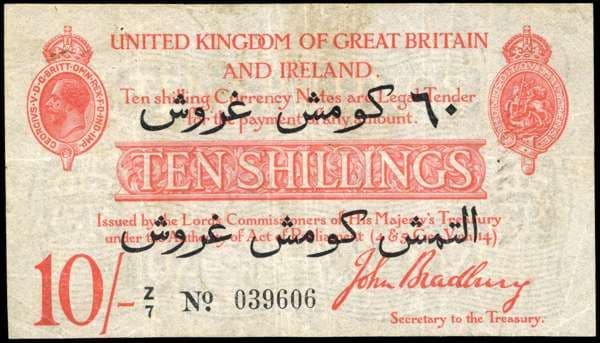
One of the more interesting banknotes being sold by Baldwins at their banknote auction on the 29th. of January is a ten-shilling note that was specifically used for the Gallipoli Campaign in 1915. It is the regular issue British ten-shilling note, signed by chief cashier J Bradbury - but over-printed in Arabic are the words ‘60 Silver Piastres’ (lot 9). These notes were specifically issued for use by British and Anzac troops in the Alexandria area, their base in preparation for their invasion of Gallipoli.
Banknotes
The Dardanelles over-print ten shillings note
Richard Gladdle
16 January 2026
Everyone knows of the Gallipoli campaign and the part played in it, not just by British troops, but particularly Australian and New Zealand soldiers.
Gallipoli was one of the greatest disasters of World War One for the Allies. The campaign took place between 25th April 1915 and 9th January 1916 on the Gallipoli peninsula in the Ottoman Empire and was the brainchild of Winston Churchill. He put forward the plan on 25th November 1914 - that there should be a new war front in the Dardanelles and the plan was agreed by the War Office and British troops in Egypt were put on high alert. Churchill’s plan was to present the German army with a third front – in addition to their Eastern and Western Fronts – and force them to pull back men to support the Turkish Army on this new third Front. The Turks were seen as a particularly weak member of the Central Powers so Churchill felt that they would capitulate with little effort.
However, the plan proved to be over ambitious – especially re. the nature of the objectives, the underestimation of the logistical problems involved and the enemy's capabilities, and the almost total absence of secrecy. The base they chose to prosecute this campaign was Alexandria but to make matters worse, the build-up of troops became very obvious due to the slowness of this part of the operation.
Alexandria, although some 2,000 miles from the United Kingdom, with its spacious quays, cranes, lighters, tugboats and plentiful labour, was the obvious choice. Yet it was nearly 700 miles from Alexandria to Gallipoli.
On the 3rd. of December 1914 Units from the AIF begin disembarking in Alexandria, to begin training. The photograph below shows Australian Soldiers of the 13th Battalion of the AIF (Australian Imperial Force) preparing for embarkation upon transports at Alexandria. Alexandria was a key hub of operations for all the British troops planning and execution of the Gallipoli land campaign.
In February 1915, the Allied fleet set sail for the Dardanelles. An amphibious landing on the Gallipoli peninsula began in April 1915. In January 1916, after eight months' fighting, with approximately 250,000 casualties on each side, the land campaign was abandoned and the invasion force was withdrawn.
These notes were issued to the Allied troops for use in Alexandria – not actually for the period of preparation for the campaign, but rather for ‘during’, when Alexandria was also used to evacuate the wounded. In late 1914 there were 2 hospitals for the troops stationed in Egypt, one at Cairo and one at Alexandria. In early 1915 vast camps had been established to accommodate the large numbers of British, Colonial and Indian troops for training in Egypt. With great numbers of troops and animals crowded together within a limited area and for a prolonged period, sickness and disease outbreaks resulted amongst the troops. On the 25th & 26th April the first landings at Gallipoli were a disaster and within a few days the wounded poured into Egypt with 16,000 cases arriving in the first ten days alone. The AIF established No. 1 Australian General Hospital at the Heliopolis Palace Hotel in Cairo on 25 January 1915. The hospital's capacity quickly increased from 200 beds to 1000. The R.A.M.C. had to deal with this sudden enormous influx of wounded from Gallipoli as well as the disease stricken from the camps and soon all the hospital beds were full. Convalescent Depots were soon established at Mustapha near Alexandria by requisitioning suitable large
buildings e.g. hotels in order to free up hospital beds of convalescing men. At the beginning of 1915 the medical services had 2,000 hospital beds in Egypt, by May this had increased to 13,000 and eventually the number reached 36,000 by the end of the year. During the Campaign itself, from May 1915 to Dec 1915, several thousands of wounded and / or disease stricken men landed in Egypt for medical attention (some after treatment and convalescing resumed service whilst those permanently incapacitated were placed on Hospital Ships to return home) and it was the R.A.M.C. who were responsible for the provision of everything the men needed - from medical services , basic needs and supplies such as food clothing toiletries, to the arrangement of transport with the Hospital Ships
Small denomination notes were thus very much needed that would be accepted by the local Alexandrians in a language they understood and denomination that conformed with their own. From Inland Revenue records, we now know, the notes were overprinted from May to November 1915 and so it would appear that they were for use in this latter period, ie. during the campaign when there was a massive influx of woundedinto Alexandria. The day-to-day purchase of food and provisions, especially for providing the wounded with essentials was thus enabled as it was also for those providing the care.
Over one and a half million ten-shilling notes were over-printed in Arabic, although a good proportion of those were officially destroyed and today only a few have survived. This note is an interesting memento of a particularly poignant episode of the First World War