
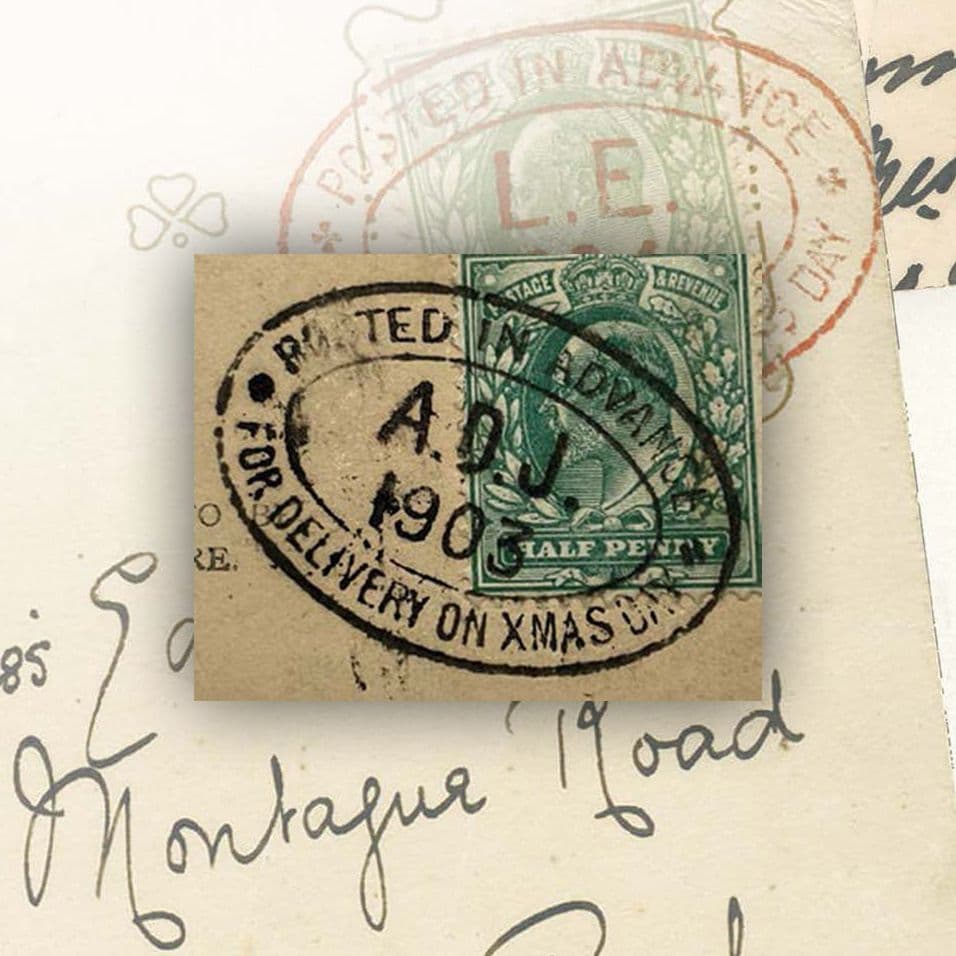
In the early years of the 20th century an experimental scheme was set up, initially in the Manchester area, to encourage the public to post their Christmas mail early for delivery on Christmas Day. Several distinctive postal markings were created for the experiment which offer a fascinating aspect of postal history.
In the early 20th century, Christmas was one of the busiest periods of the year for Britain's post offices. The service was very different from today. There was no first or second-class delivery; all deliveries were treated the same. The expectation was that the deliveries would be made by hand the next day, making it impossible to sort out the mail in time for Christmas.
An experimental scheme was set up in Manchester to encourage the public to post their mail early for delivery on Christmas Day. The aim was to reduce the pressure on postal staff and ensure that Christmas cards and letters arrived on time. These items received distinctive postal markings and handstamps that are a highly collectable aspect of postal history.
The Rochdale Trial of 1902
John Phillips, a surveyor for the Manchester district, wanted to solve the postal issues during Christmas. He designed the idea 'posted in advance' in 1902 and chose Rochdale for the first trial; it had the right population size, and the postmaster was keen to participate. He distributed posters inviting the townspeople to their local post offices between December 17th and 22nd, so that they could request delivery for their Christmas letters. Their letters would then be marked explicitly with a special postmark, later being stored away and delivered on Christmas Day.
Eighteen thousand one hundred ninety of these postmarks passed through the system, making it highly prized by collectors. Red ink was used to cancel the halfpenny green stamp, while the penny red stamp was cancelled by black ink. The more challenging to find postmark is the black version than the red.
Expansion of the ‘Posted in Advance’ Scheme in 1903
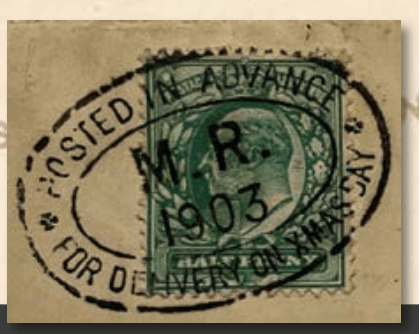
Since this experiment was successful in Rochdale, it was extended to the entire city of Manchester, resulting in 28 towns participating. The Post Office introduced a new postmark that displayed the town or city of origin using the telegraph initials of each participating location.
Although all the towns and cities never participated, places like Cheltenham took a different approach. While they still used their standard cancellation, they took out part of the date and used red ink, making only a couple of these cancellations known today.
Postmasters held a review in 1904, and the initiative did not receive the response it was expecting. People said that it harmed postal deliveries since it added more work. However, not all locations responded in the same way. In Manchester, Christmas Day deliveries were completed by 1:15 pm, which is an improvement from previous years. By contrast, when the experiment results were compared to smaller towns like Knutsford, which only had 725 advance postings, it reinforced doubts about the experiment's effectiveness.
No examples of Knutsford strike were known for 1904, so when one came to a recent auction, it challenged the assumption that the town did not repeat the experiment and confirmed that new material still has to be discovered.
Christmas Mail Experiments in 1904–1905
By 1904, participation in the scheme had fallen, with the number of towns involved dropping from 28 to just 14. Most of these were located in the Northwest around Manchester, although Carlisle, Glasgow, and Leicester also participated. Carlisle chose to adapt its standard postmark, producing a red cancellation that is now exceptionally rare, with only 1,000 items known to have been franked in this way.
In contrast, interest in Manchester continued to grow, with the number of cards and letters set aside for Christmas Day delivery rising to around 300,000. Despite this local success, overall support continued to decline, and by 1905, the number of participating post offices had further reduced to just eight.
Expansion to Liverpool and Machine Cancellations, 1906–1907
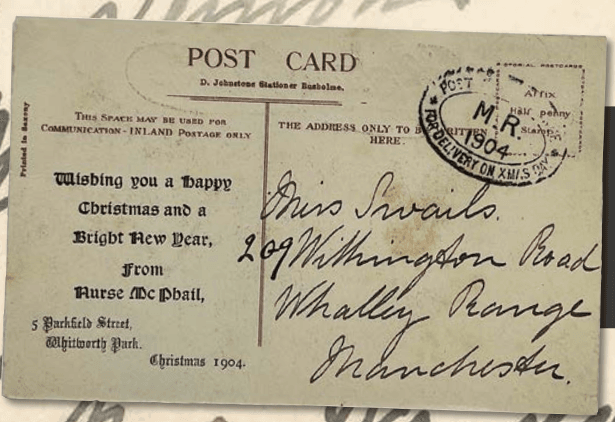
John Phillips retired in 1906 and was replaced by John Muir. He wanted to expand the idea, so he started working with Francis Salisbury, a surveyor for the Liverpool district. This collaboration allowed Christmas mail to be delivered across both district boundaries, rather than being limited to local areas. This also introduced a new cancellation. During Christmas 1906, a total of 393,000 items were handled in the Manchester district, with a further 277,000 in the Liverpool district, meaning that most of the mail came from these areas.
While both towns participated in 1907, Manchester experienced a significant change in advanced posted mail. The amount increased from 340,000 to 546,100, which added pressure to manual cancelling. To help, post offices introduced a Christmas cancellation machine.
The Final Years of the experiment (1908–1909)
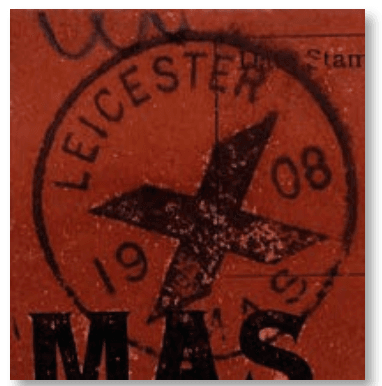
The final stages of the 'posted in advance for Christmas' were in 1908 to 1909, and the experiment ended with the new additions of Norwich, Leicester and Reading, allowing mail to be delivered anywhere in the UK. John Muir retired in 1908 and was replaced by Matthew Gardiner. In 1909, the volume of mail in Manchester decreased by a third, which played a key role in bringing the scheme to an end.
Why the ‘Posted in Advance for Christmas’ experiment Ended
The experiment ultimately concluded in 1909, and it was not as successful as the postmasters had anticipated. Not only was it a disappointment in Liverpool, but it was also costly due to space issues. Therefore, it was believed that the time and money spent would be more beneficial if they used it on persuading the public to post Christmas mail earlier.
Although the 'posted in advance for Christmas' service ran for a short period, it revealed the pressure on the postal system to manage demand during the holiday period. While the experiment was practical in large areas, such as Manchester, uptake elsewhere was inconsistent. Nevertheless, the experiment left special cancellations that are of great interest to collectors today