The Military Guinea
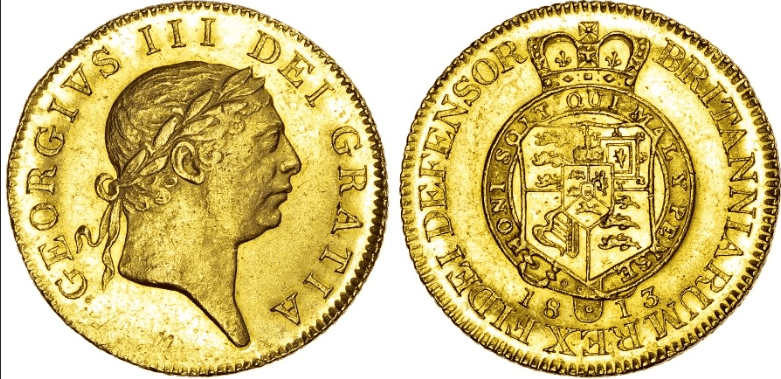
In Baldwins auction on the 22nd of July one of the coins being sold is a gold Guinea dated 1813 of George III (lot 142) - nicknamed the 'Military Guinea'.

Richard Gladdie
17 June 2026
In Baldwins auction on the 22nd of July one of the coins being sold is a gold Guinea dated 1813 of George III (lot 142) - nicknamed the 'Military Guinea'.
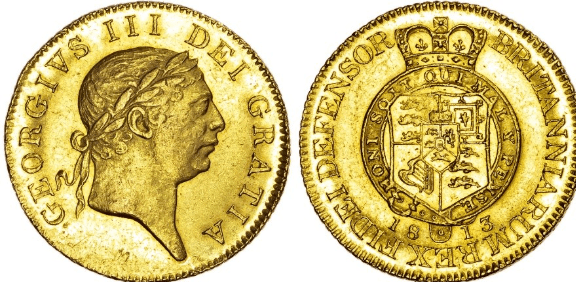
The guinea was worth 21 shillings and this 1813 issue was the last guinea to be struck in Britain. However, this is not why it is particularly remembered; for more importantly, it was specifically issued for payment of Wellington's troops in the final months of the Peninsular War. Thus, their initial circulation was not in Britain, but rather in Spain!
The Royal Mint in London struck some £519,722 worth of Guineas, Half Guineas and Third Guineas between February and June 1813, producing about 361,473 'full' gold Guineas on new steam-powered presses. These machines were developed by Matthew Boulton at his Soho Mint, near Birmingham, and installed at the Royal Mint's new Tower Hill premises. The 1813 Guinea would be the first (and last) circulating Guinea struck at Tower Hill. Gold was scarce, due to the great expense of funding the war with France - and acquiring the metal to coin the 1813 Guinea was difficult for the government. So much of the gold to produce the coins had to be imported from India in the form of gold Mohurs and Pagodas.
Soldiers needed to be paid, and gold coin was a specie that could be used to buy provisions, goods and even 'entertainment' where they were stationed. The issue of these coins was only part of a broader effort to fund the final months of the Peninsular War. Their production coincided with Wellington's establishment of a secret mint at Saint-Jean-de-Luz, just over the border in France, to forge silver French Five-Franc pieces from Spanish and Portuguese Dollars.
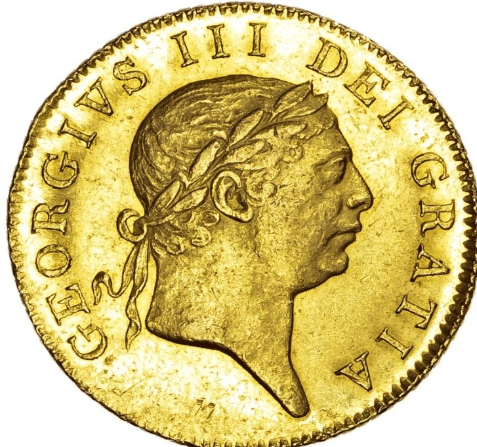
The dies for the Military Guinea are attributed to the engraver Lewis Pingo and the deeply unflattering, short-haired, laureate bust of George III on the obverse was designed by Nathaniel Marchant. The reverse is more decorative than the spade guinea that circulated in Britain, in that there is a more intricately detailed crowned square-topped shield of royal arms encircled by a garter.
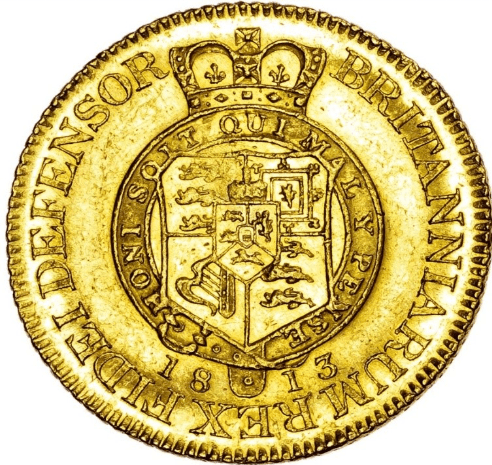
These guineas came back from Spain to Britain with the victorious troops and circulated alongside the existing spade guineas, but then a few years later in 1816, with Britain broke after the war, was the Great Currency Reform and a slightly smaller (by 5%) gold coin came into being, the 'sovereign' and thus this guinea was the last ever to be minted.
In good condition the 'Military Guinea' is scarce, and they do indeed have a very interesting history. The one in Baldwins auction is in good Extremely Fine condition with proof-like brilliance and is expected to sell for between £6,000 and £7,000.