A Stunningly rare Iranian Pattern Half Toman
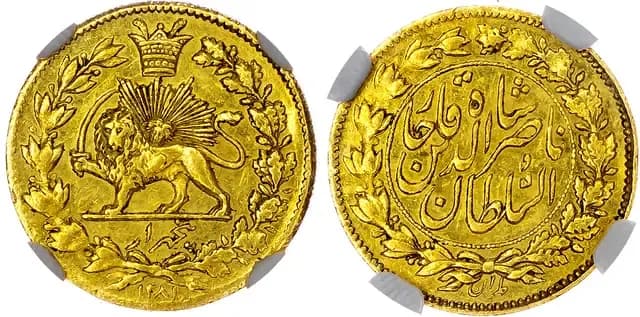
One of the most fascinating lots in our 131st Ancient, British, and World Coin Auction is the Half Toman (Lot 294) from the reign of Nasir al-Din Shah in Iran (AH 1264 – 1313, 1848 – 1896 AD).

Ema Sikic
29 June 2026
One of the most fascinating lots in our 131st Ancient, British, and World Coin Auction is the Half Toman (Lot 294) from the reign of Nasir al-Din Shah in Iran (AH 1264 – 1313, 1848 – 1896 AD).
Tomans and Half Toman were often given as gifts for Norwuz (Iranian New Year) or on the occasion of the ruler’s accession. The lion and sun design found on this coin was a standard feature for coinage in the Qajar dynasty from around 1842, and was common on Nasir al-Din Shah’s coins from AH 1274 (1858).
A key aspect of Nasir al-Din Shah’s reign is the shift from producing hammered coins to milled coins in AH 1293 (1876), yet this Half Toman dates to AH 1281 (1864). As early as the 1850s, some early experiments in producing machine-made coins took place in Tehran and Tabriz, using tools found in the Ottoman Empire. However, it seems that hammered coins were also produced concurrently. For example, evidence exists of dies from the Tehran mint dating to AH 1281 (1864), but the coins themselves were known not to have been released into circulation until AH 1294 (1877). In AH 1281 (1864), experts arrived from France at the request of the Shah to implement a plan to use steam-powered presses to strike coins, but they did not have much success. The Shah’s scheme was finally put into practice in AH 1293 (1876), when a team led by the head of the Austrian imperial mint, Franz Pechan, launched the imperial mint of Iran, despite resistance from the general public.
Nasir al-Din Shah took a great interest in Europe and the Ottoman Empire, and he was extremely keen to bring their technologies and expertise to Iran. It is not unsurprising, therefore, that he wished to align with their methods of producing milled coins; these areas had abandoned hammered coins around 200 years prior. Nasir al-Din Shah was also heavily involved with the Dar al-Farnun, the first European-style higher education institution in Iran, which taught sciences, medicine, military training, and later photography, music and painting, all in a European or Ottoman style. The Shah regularly endorsed funding awards to students as an incentive to study there. The Dar al-Farnun was also linked to many state-run facilities, such as the printing press, the board of translators, the censorship office and the telegraph office.
In the 1860s, a secret society was established at the Dar al-Farnun which was said to display questionable political motives. Nasir al-Din Shah (having already survived an assassination attempt a few years prior) grew suspicious of the society, and withdrew his financial support for the institution, which proved very damaging for the economy. This was not helped by the fact that this was a period of famine in Iran at the time.
During this economic decline, the Shah’s interest in European expertise remained, but this ultimately proved to be the downfall of the Iranian economy. The Shah began sharing Iranian resources with European countries in exchange for their expertise and technologies rather than monetary payment. In AH 1289 (1872), a contract was signed with Baron Julius de Reuter which gave Britain complete control over Iranian roads, telegraphs, mills, factories and forests. The deal granted Britain full profit from these amenities for 5 years, and 60% of profits for a further 20 years. When this was met with significant protests from the Iranian workers, Nasir al-Din Shah remained dogmatic in his approach, less overtly, by continuing to give away Iranian commodities to Britain and Russia, in smaller, less noticeable transactions. This was extremely unsustainable for Iranian economy, therefore the milling of coins may have been a small attempt to quell the steady economic decline they were experiencing, by producing coins in a faster and more cost-effective way.
This Half Toman is the inception of one of the pivotal developments in Iranian numismatics, the production of exclusively milled coins, also reflecting the impact that Nasir al-Din Shah’s fascination with Europe and the Ottoman Empire had on realising these changes. Any buyer would be lucky to own a coin with such a fascinating history.
The British, Ancient & World Coins - Auction 131 will take place live from London and online on Wednesday 22nd July 2026 at 10.30 BST