
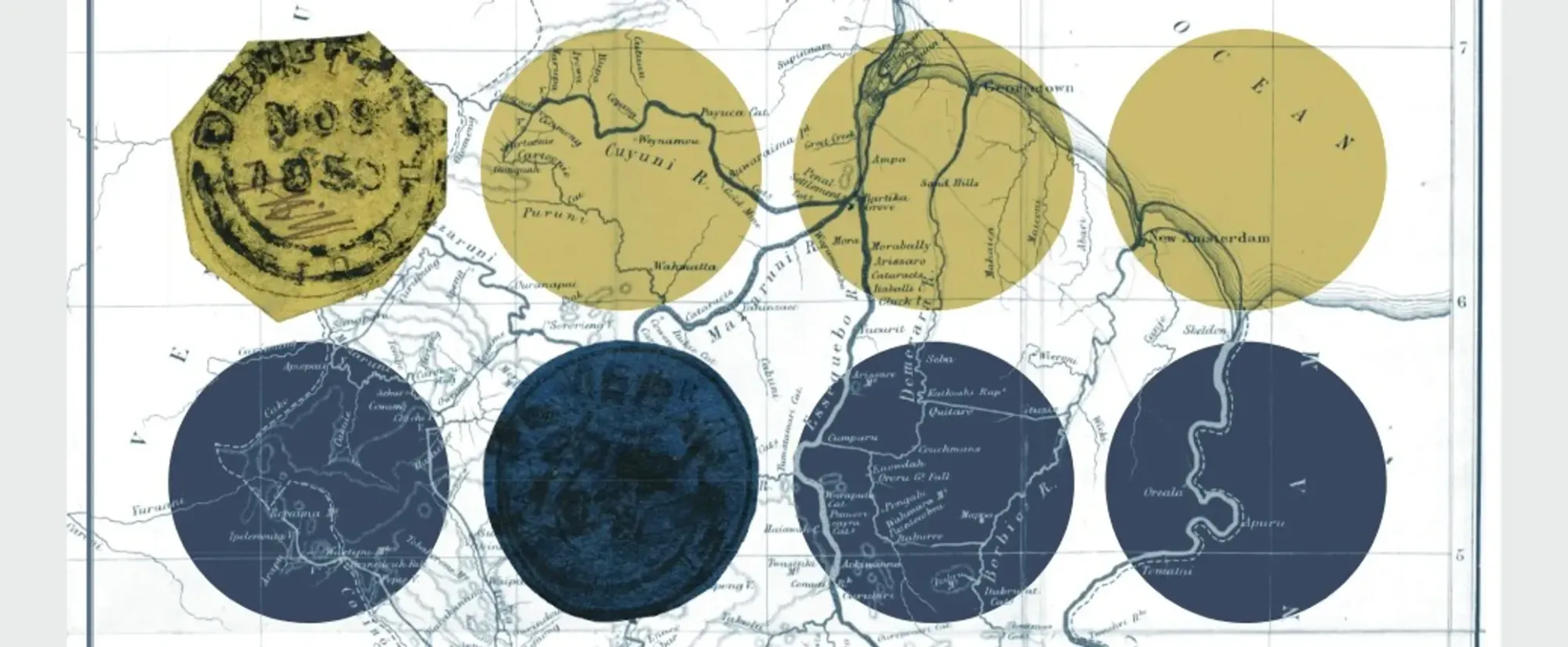
The first stamps of British Guiana were locally designed and produced in 1850, so it became the fourth British Colony to issue its own stamps. It had been decided that the very basic inland post (mainly serving sugar plantations) needed upgrading to a daily service, with the charges being pre-paid by means of postage stamps. There was insufficient time before the planned issue date to order stamps from London, so they were ordered from the local printers of the Royal Gazette. Different values were required to reflect the distances and charges involved, with the denominations being 4ct, 8ct and 12ct (a 2ct for local delivery in Georgetown was introduced in the following year).
The Williams brothers described the issue as ‘The crudest classic issue by a government Post Office in what used to be called the British Empire’. They were produced on variable-quality paper by the simplest of methods, were scribbled on as a matter of course and are, indeed, crude. The French have an expression which well describes their appeal, which has passed into English; jolie-laide (literally, ‘pretty-ugly’). To justify the use of the expression, they are attractive despite their crudity, in the same way as some of the Indian States local printings, and have long been celebrated for their rarity and ephemeral charm.
E.T.E. Dalton was the Deputy Postmaster of Demerara and was responsible for issuing the official notice announcing the issue. However, when he saw the stamps prior to their issue, he was very aware of their lack of sophistication and felt that some additional form of security was necessary (“As they could be imitated in any printing office, I was obliged to counter-sign them. They were of the most ordinary workmanship...”) The decision was taken that each stamp should be initialed by a postal official as an additional protection against forgery.
The stamps were produced to a very simple design, with the values in italics in the centre of the stamps and BRITISH/GUIANA around the edge inside a circle, which was made from printer’s brass rules bent to shape. The stamps were printed in black on differently-coloured papers to ensure easy recognition of the values; the 2ct on rose, the 4ct on shades of orange and yellow, the 8ct on green and the 12ct on blue (shades to indigo). While the sheet format is not known, it seems likely that the stamps were printed in rows of four, one each of four types, at least two rows to a sheet. The largest vertical multiple is a pair (necessarily of the same type), so it may well be that the sheets were composed simply of two rows of four.
Only two examples of unused ‘Cotton-Reels’ have been recorded, and one of them disappeared after its sale in a Harmer Rooke auction of 1935; the other surfaced in the John E. du Pont sale in 2014. Both are 12ct values. The 12ct also boasts two varieties, one showing a straight foot to the ‘2’ of ‘12’, the normal foot being curved. Few are known. Even rarer (and currently catalogued at £250,000) is the variety with the ‘1’ of ‘12’ omitted; just one example is recorded.