Lot 351
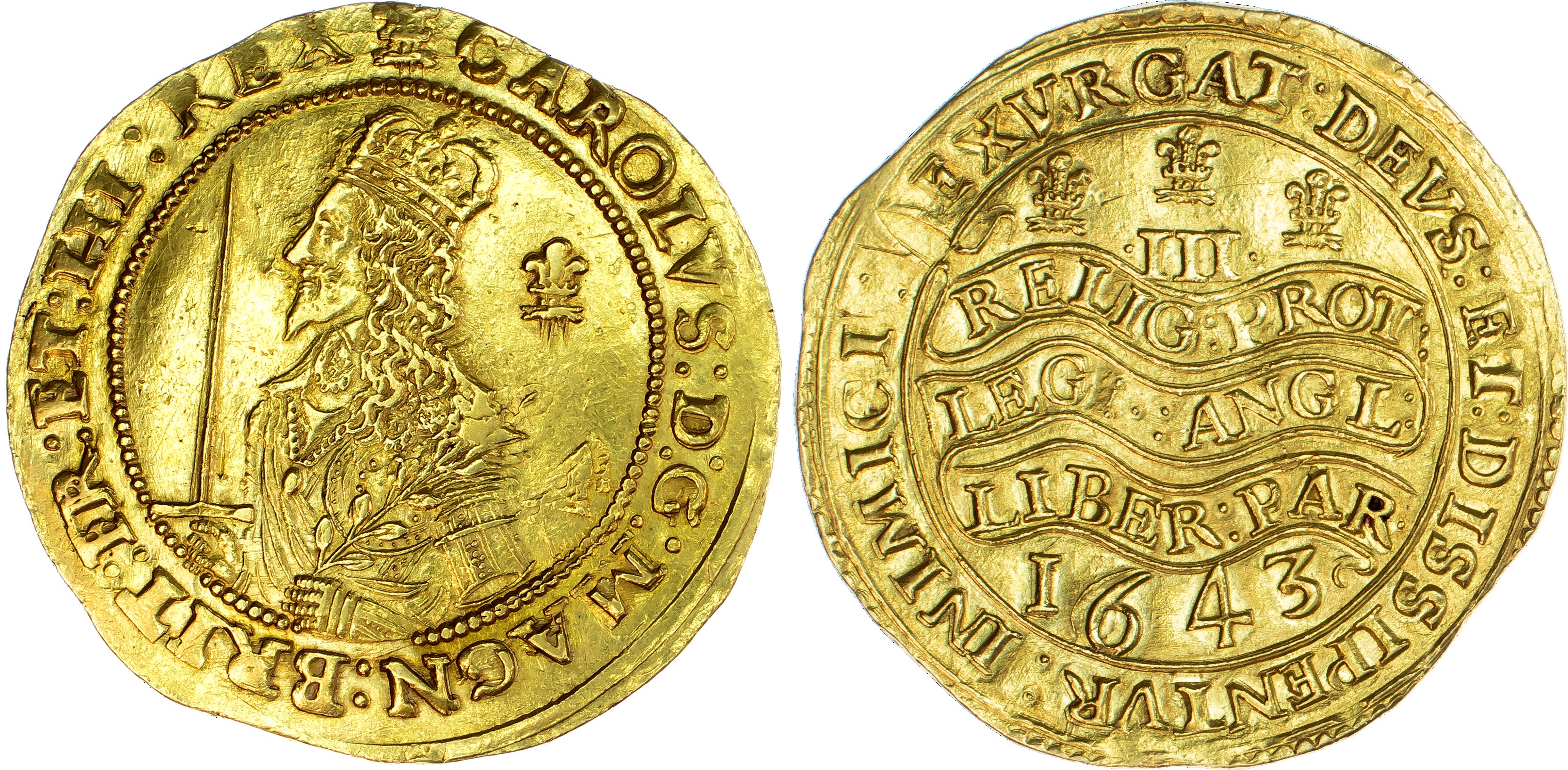
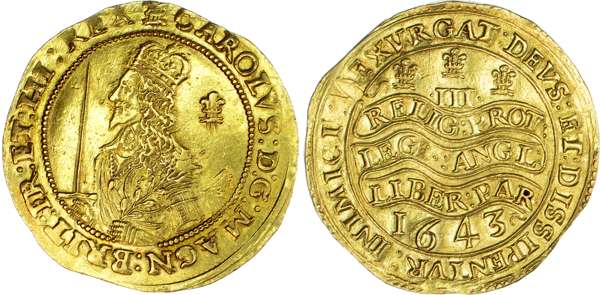
Charles I (1625-1649), Oxford mint, Triple Unite, 1643, mm. plume with bands on obv. only, bust left holding sword and olive
Ancient, British and World Coins, Tokens and Medallions | 111
Auction: 5 July 2023 at 09:50 BST
Description
Charles I (1625-1649), Oxford mint, Triple Unite, 1643, mm. plume with bands on obv. only, bust left holding sword and olive branch, scarf behind, plume in field, CAROLVS: D:G: MAGN: BRIT: FR: ET: HI: REX. Reverse Declaration on scroll in three lines RELIG: PROT LEG: ANGL: LIBER: PAR, colon stops, 26.98g/7h (B-J V-S5; SCBI Schneider 291; SCBI Brooker 836; N 2383; S 2726). About extremely fine and probably about as struck for issue, portrait bold and well struck. None of the double striking as so often found with this extremely rare variety.
Ex. Ira & Larry Goldberg Auctions, 7th of June 2016. Lot 2283. (Hammer $90,000 (62,000gbp)).
It would appear this coin was originally encapsulated by NGC in the Goldberg’s sale as AU50. This certainly does not do the coin justice and hence most likely why it has since been removed.
This classic from the English Civil War, struck at the king's temporary mint at Oxford, which served as Charles' headquarters and principal source of money from 1642 to 1646, carries not only a powerful image of the frightened, pursued king but also his famous Declaration made at Wellington in 1642 in which he extolled the Protestant religion and laws of his kingdom as well as the liberty granted to his subjects and protected by himself and his parliament. This appears on the verso side of many of his coins, in largest form on the famed Triple Unites, which carried immense "face value" and served his army by purchasing supplies for war. Unfortunately for Charles, his parliament saw things through a different lens, one without him as ruler. The king's proclamation essentially was a declaration of war against his legions of Puritan opponents and parliament's army, led by Oliver Cromwell. Oxford and the other regional mints, quickly assembled as the king moved from one fortified locale to another, served the purpose of converting gold in other forms (older coins, jewellery, plate) into coins asserting Charles's kingship, and paid out to his armies as well as to suppliers. While technically not all of these are siege coins, most pieces struck at the temporary mints met exactly the same fate -- melted in order to make newer coins after the war. Within six years of the minting of this impressive coin, Charles was captured and executed. At his demise, the ancient divine right of kings eff ectively ended in across the land, and upon the Restoration in 1660 England became parliamentarian in both name and power. The huge Triple Unites made of gold fared poorly. Few exist today. All are prized by numismatists as the ultimate artistic expressions in metal of their era.