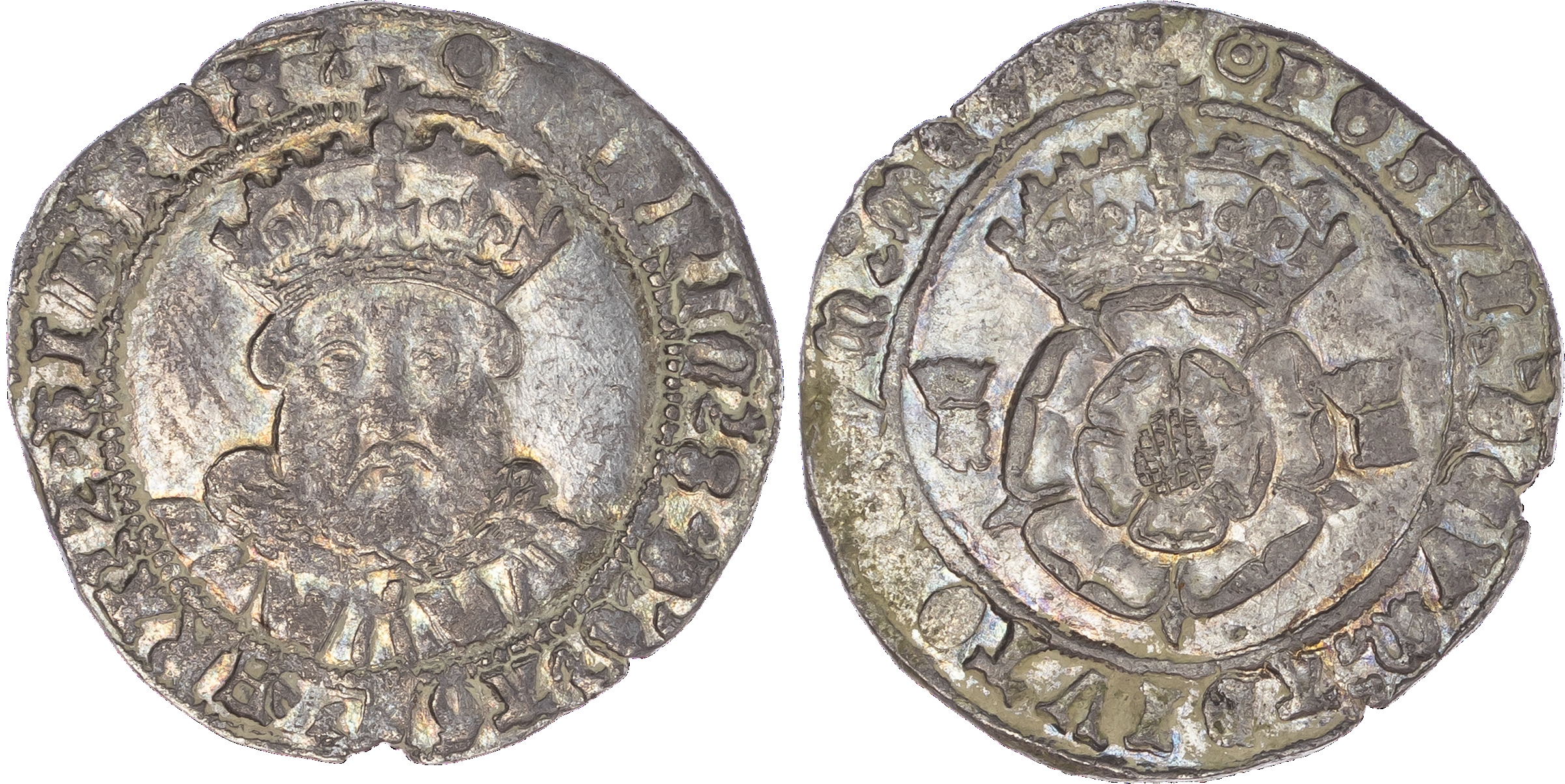

Lot 341
Henry VIII (1509-47), Testoon with a nominal value of twelve pence, issued at Tower mint, Third coinage (1544‑47), mintmark
Ancient, British and World Coins, Tokens and Medallions | 111
Auction: 5 July 2023 at 09:50 BST
Description
Henry VIII (1509-47), Testoon with a nominal value of twelve pence, issued at Tower mint, Third coinage (1544‑47), mintmark pellet in annulet, facing crowned bust of King in ruff, cross on crown breaking inner linear beaded border, legend reads HENRIC 8 D GRA AGL FRA Z HIB REX. Rev, crowned Tudor rose, crowned h and R flanking, saltire stops, reads POSVI DEVM ADITOERIVM MEVM, Lombardic E’s, Roman R’s, sleeve stops both sides, 7.34g (S.2365; N.1841; Jacob O 16 var/R 19). Fully centred strike on good metal, symmetrical flan with the exception of one flan edge striking flaw at 6 o’clock. Superb nuanced portrait in the manner of Holbein the younger, further elevated by much of the original mint bloom manifesting as shocks of blonde gold, some subtle field die flaws. Legends legible in the main with few areas of distortion or fade, the reverse Tudor rose especially bold. An exemplary example of arguably one of the most fascinating denominations in the English series. Extremely fine, a problem free example, rare.
Ex. DNW, Sale 63, 7th October 2004, lot 265.
Realistic portraits on British coins had only replaced stereotyped images of kingship in the last reign under Henry’s father, Henry VII, whose portrait Testoon by the Flemish engraver Alexandre de Bruchsells was seminal. In Henry VIII’s first coinage (1509‑26) he continued to employ his father’s effigy, however in the smaller coins of the second coinage (1526‑44) his own young bust appears. Within the third and final coinage (1544‑47) a Testoon emerged with a vivid depiction of his older self, a bearded crowned rugged bust facing forward, an image reminiscent and evocative of the famous Holbein portraits. Concurrently, this was a time of frequent debasement and from the traditional sterling 11 oz 2 dwt. this issue was progressively debased down to 4 oz. 2 dwt. At this low level the thin silver coating would often erode on the high points revealing the base core, giving Henry the byname ‘old copper-nose'. This is an exceptional specimen despite a somewhat soft strike, extremely rare so well preserved, considered rare irrespective of their condition. The Testoon of Henry VIII is one of the key coins in English Tudor numismatics, but also qualify as European renaissance portrait pieces of art.