Lot 5
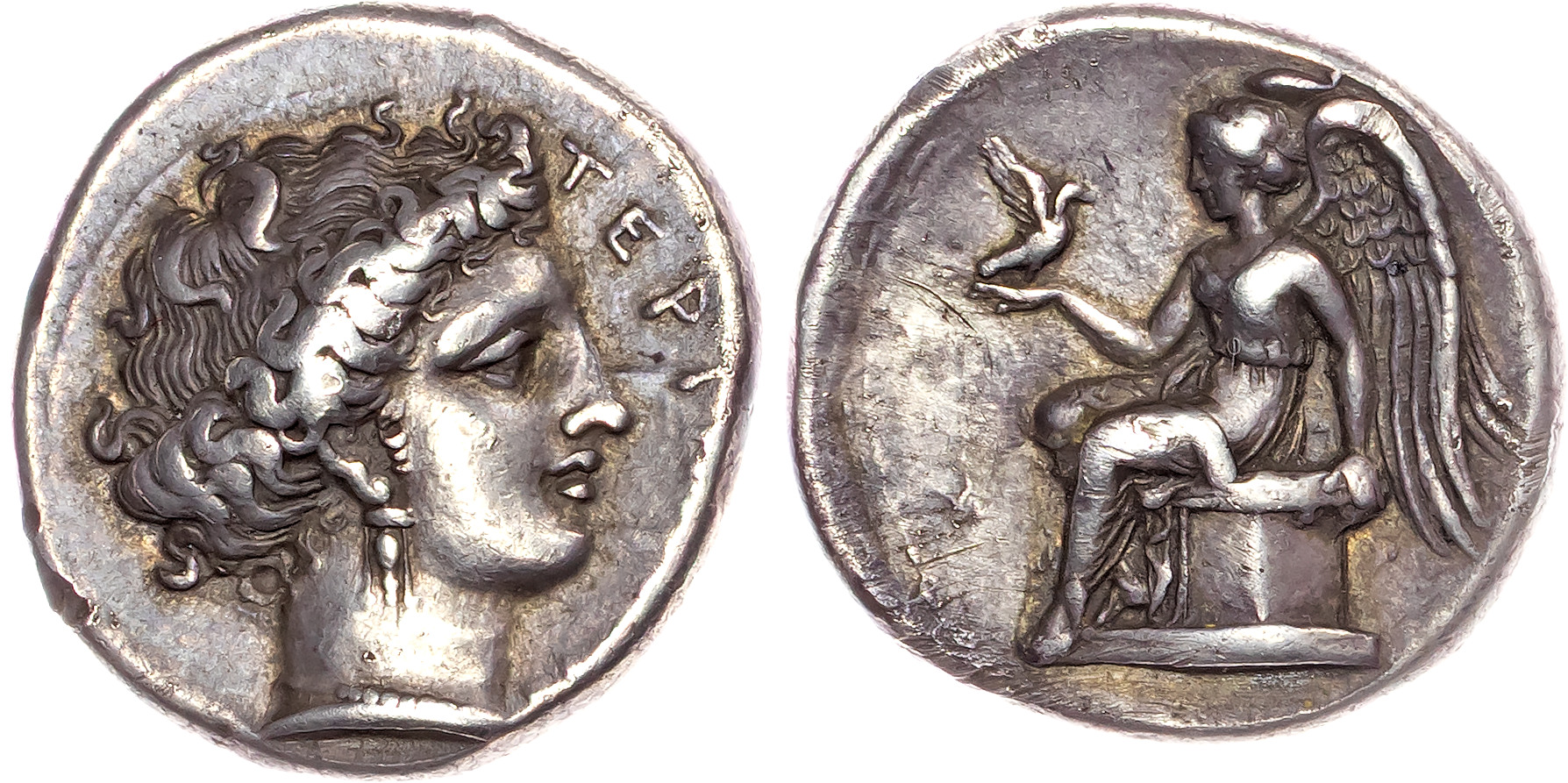
Bruttium, Terina (c. 420-400 BC) AR Nomos, 7.68g.
Auction: 23 November 2026, 10:30 GMT
Description
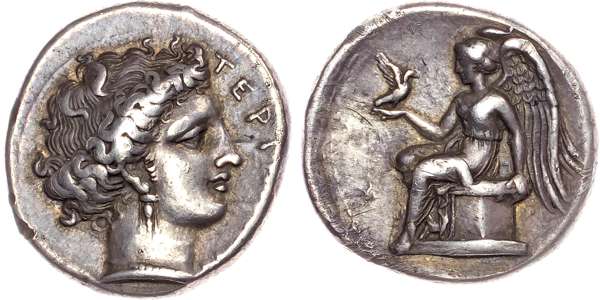
TEPINAIΩN, head of the nymph Terina right, wearing triple-pendant earring and pearl necklace. Rev. Nike, wearing a chiton and a himation, seated to left on a cippus, the base of which is shown in perspective, holding a bird in her right hand and resting her left on the cippus. (Regling, Terina 80 (dies MM/ρρρ); Holloway & Jenkins 84 (same obverse die); HN Italy 2629; SNG ANS 852 (same obverse die); SNG Lloyd 761-2 (same obverse die); BMC 41 = GPCG p. 46, 25 (same obverse die); Basel 242; Gulbenkian 154 (same obverse die); Kraay Hirmer pl. 97, 280). Nearly Extremely Fine; a few marks beneath a pleasant old cabinet tone. Superb classical style. A beautiful coin.
The Classical coins of Terina allude to refined skill on the part of the engravers responsible for their design. The most well-known coins of this Magna Graecian city bear portraits of the local nymph, Terina, juxtaposed with a seated Nike. Reverse types like this would inspire one of the greatest die engravers of milled coins, over two thousand years later. William Wyon’s famous Waterloo medal was given to the victorious soldiers, regardless of rank, following Wellington’s great victory in 1815. The iconic piece features the portrait of the Prince Regent, with a familiar-looking seated Victory on the reverse. The reverse bears a striking similarity to two coins from antiquity, which Wyon no doubt looked to for inspiration. The first is a silver stater from Olympia in Elis, and the second is the piece from Terina which we see here. W. S. W. Vaux, writing in a 19th Century publication of the Numismatic Chronicle, remarks of Wyon’s Waterloo medal:
‘The type is a copy of a very beautiful Greek coin of Terina, in Lucania. The art, however, we are afraid we must admit, is very inferior to that of its ancient original’.
Vaux, W. S. W. (1869), On English and Foreign Waterloo Medals, Numismatic Chronicle. Royal Numismatic Society.
Footnote